
As the automotive industry increasingly adopts advanced materials like carbon fiber and fiberglass, many customers face challenges when choosing the right option for their car parts. At Shasha Carbon Fiber, a leading manufacturer in the field, we often see customers torn between these two materials. Donc, what’s the difference between carbon fiber and fiberglass?
Simply put, carbon fiber is stronger, plus léger, and more rigid than fiberglass, but it comes at a higher cost. Fibre de verre, d'autre part, is more flexible, rentable, and still offers a high strength-to-weight ratio, making it ideal for applications where budget constraints are a factor.
This article will deeply discuss carbon fiber and fiber glass, and then compare their difference in the strength, élasticité, poids, résistance à la chaleur, résistance chimique, et le coût. By the end, toi’ll have a clearer understanding of which material is best suited for your needs, whether you’re in the automotive, aérospatial, or manufacturing industry.
Fibre de carbone vs. Fibre de verre: Différences clés
| Propriété | Fibre de carbone | Fibre de verre |
|---|---|---|
| Force | Carbon fiber is stronger than fiberglass, offering a tensile strength that’s more than 20% higher. | Fiberglass is strong, but not as strong as carbon fiber. It is more flexible. |
| Élasticité | Less flexible and more rigid, with a higher tensile modulus (4 times that of fiberglass). | More flexible and can withstand greater strain without breaking. |
| Poids | Lighter than fiberglass, typically about 15% less in weight. | Plus lourd que la fibre de carbone, but still much lighter than metals like steel. |
| Résistance à la chaleur | Excellent heat resistance with low thermal expansion, maintaining stability even in extreme temperatures. | Less heat resistant; may expand or contract with temperature changes, but certain types can withstand up to 7200°C. |
| Résistance chimique | Very resistant to corrosion, acids, and abrasions. | Also highly resistant to chemicals, but not as strong as carbon fiber in terms of mechanical properties. |
| Coût | More expensive to produce due to the complex manufacturing process. | More affordable, with lower production costs and easier mass production. |
Qu'est-ce que la fibre de carbone

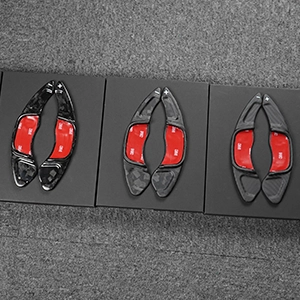
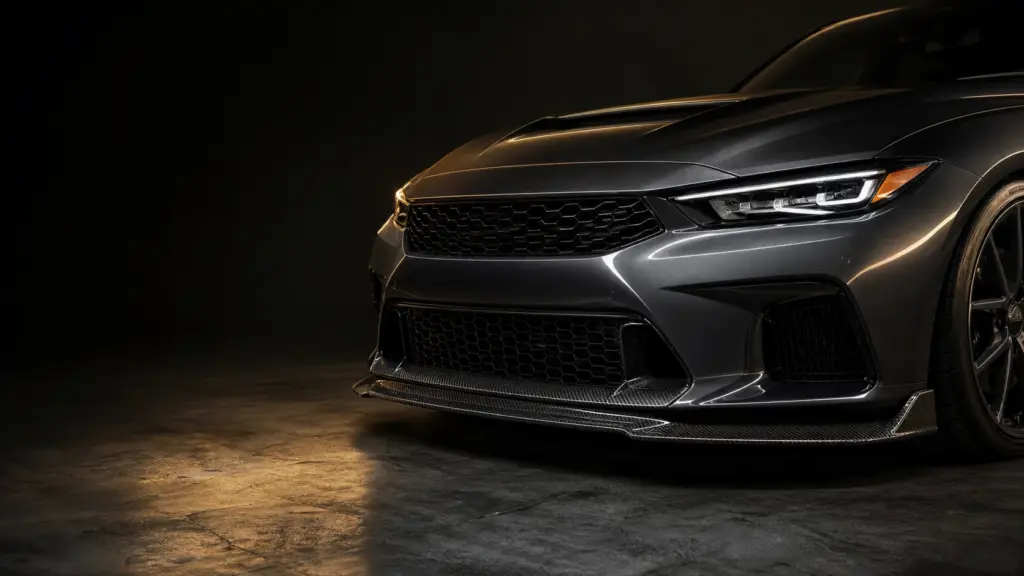
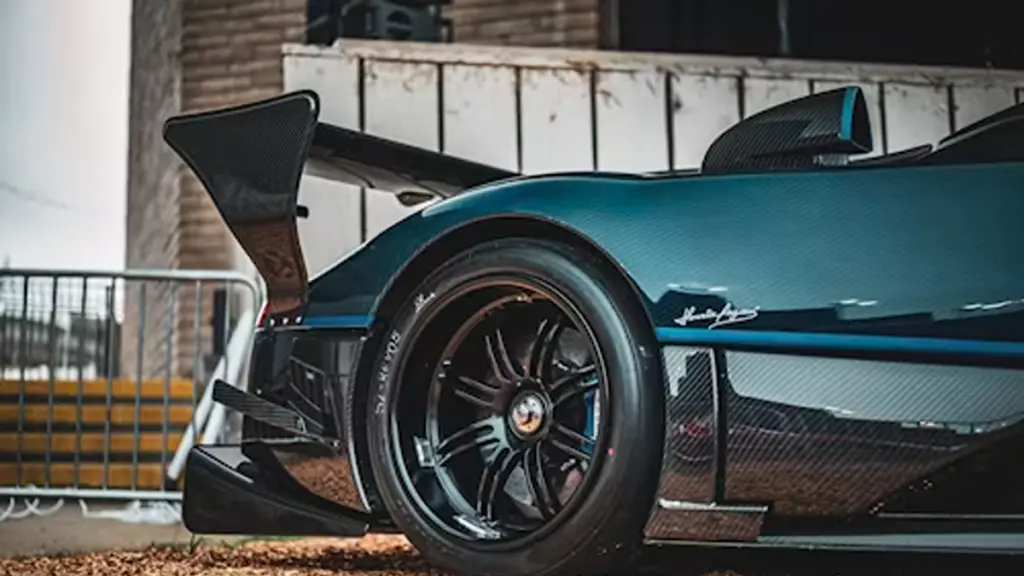
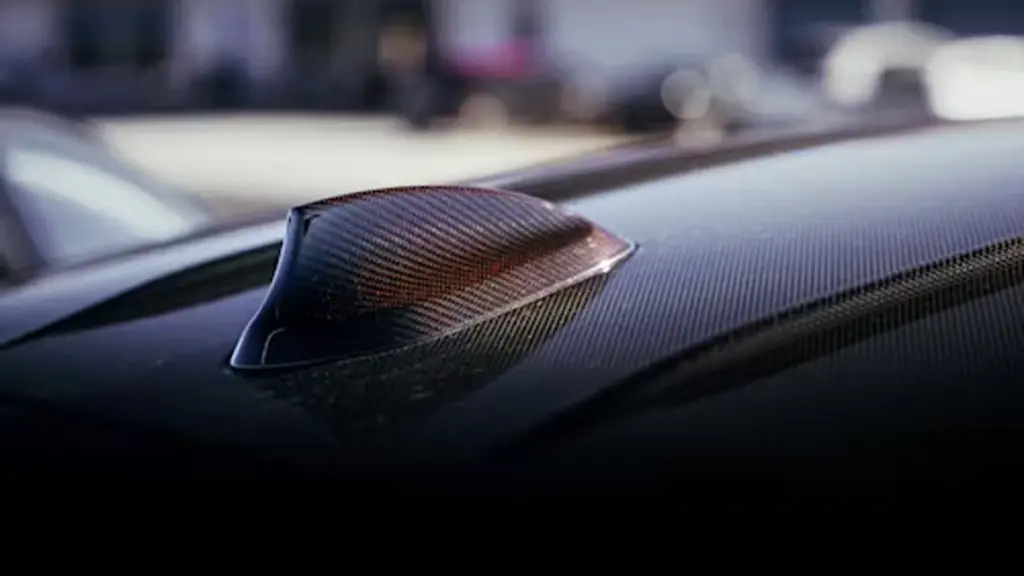
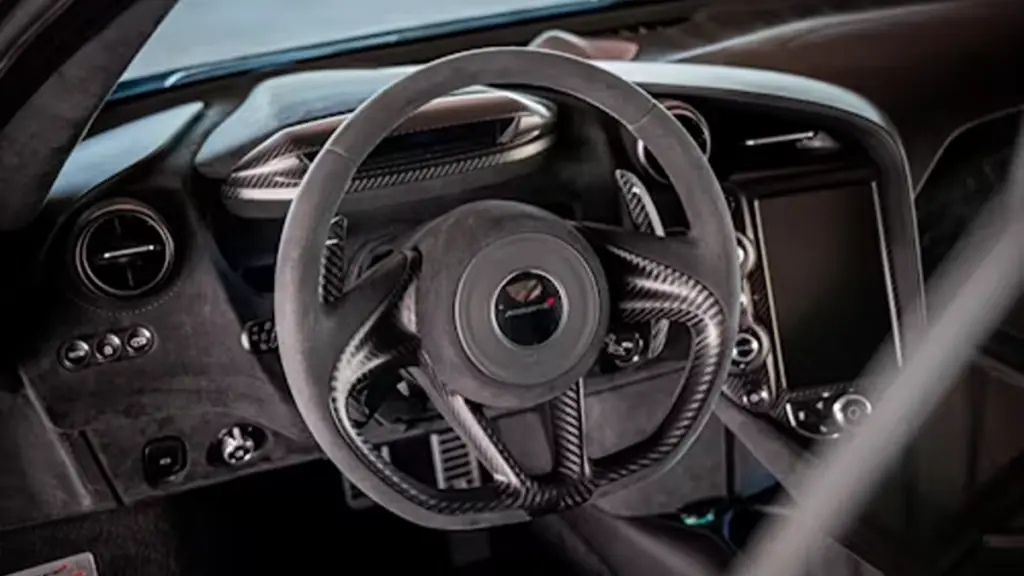
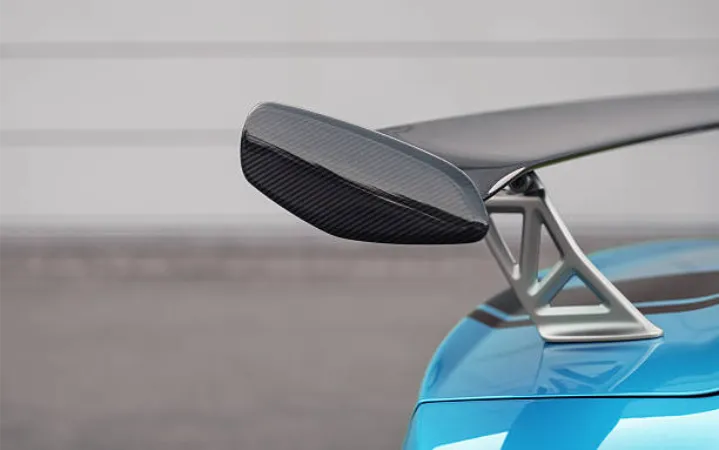
Lorsque vous regardez un salon de l'auto ou une course automobile, le public entendra souvent pièces de voiture en fibre de carbone, extérieur de voiture en fibre de carbone, ou intérieur de voiture en fibre de carbone » présenté par l'hôte. Carbon fiber is a composite material that is widely used in automotive manufacturing. À mesure que la technologie de production devient plus avancée, more manufacturers begin to provide carbon fiber car parts such as rear view mirror cases, panneaux de portes intérieures, poignées de porte, barres de décalage, sièges de course, kits pneumatiques, etc..
Carbon fiber is made through the carbonization and graphitization of organic fibers, resulting in a filamentous material with a diameter of 5-10 microns and a carbon content exceeding 90%. It is classified into small bundles (less than 24K fibers) and large bundles (more than 24K fibers). A 1K bundle contains 1,000 individual fibers.
Pros of Carbon Fiber
- Strength-to-Weight Ratio: Carbon fiber is incredibly strong and lightweight, ce qui le rend idéal pour les applications hautes performances, especially in the automotive and aerospace industries.
- Durabilité: It offers excellent resistance to corrosion, wear, and high temperatures, ensuring longevity and reliability in demanding environments.
- Rigidité: Carbon fiber is stiffer than fiberglass, which makes it suitable for applications where structural integrity is crucial, such as car parts and sports equipment.
- Appel esthétique: The distinct woven pattern of carbon fiber is highly valued in both functional and decorative applications, such as automotive interiors and exteriors.
Cons of Carbon Fiber
- High Cost: The complex and time-consuming manufacturing process makes carbon fiber significantly more expensive than materials like fiberglass or aluminum.
- Fragilité: Carbon fiber is more brittle than fiberglass and can crack or break under excessive impact or stress, limiting its use in flexible applications.
- Complexité de fabrication: The production of carbon fiber requires specialized equipment and technology, making it challenging to mass-produce and increasing manufacturing time.
Shasha Carbon Fiber is a leading manufacturer in the automotive aftermarket, committed to providing high-quality carbon fiber products. With cutting-edge technology and expert design, Shasha ensures a seamless, one-stop shopping experience for its partners and customers.
Qu'est-ce que la fibre de verre

Fibre de verre, aussi appelé fibre de verre, is a kind of inorganic non-metallic material with excellent properties, largement utilisé comme matériau industriel de nos jours. L’art de filer des fils de verre pour fabriquer des tissus est très ancien, remontant à 1713.
FFiber glass is made from extremely fine fibers of glass. The base ingredients of glass fibers are forms of silica, principalement du sable, calcaire, cendre de pierre et borax. Fabriquer des fibres de verre, le verre est chauffé jusqu'à ce qu'il soit fondu puis forcé à travers des pores ultra-fins, ce qui donne un filament de verre très fin. Monofilaments range in diameter from a few microns to more than twenty microns, équivalent à 1/20-1/5 d'un cheveu humain.
Les produits en fibre de verre sont classés en quatre grands groupes: brins coupés, mèches à tirage direct, mèches assemblées, et produits de tapis.
Pros of Fiberglass
- Cost-Effective: Fiberglass is much cheaper to produce compared to carbon fiber, making it a cost-effective option for many applications.
- Poids léger: Like carbon fiber, fiberglass is lightweight and has favorable strength-to-weight properties, making it ideal for use in various industries, including automotive and construction.
- Durabilité: Fiberglass is highly durable, offering good resistance to corrosion, produits chimiques, et abrasion, making it suitable for long-lasting use in harsh environments.
- Flexibilité: Contrairement à la fibre de carbone, fiberglass is less brittle and can withstand more strain without breaking, making it ideal for applications where flexibility is needed.
Cons of Fiberglass
- Less Strength: Fiberglass is not as strong or stiff as carbon fiber, which limits its use in high-performance applications requiring maximum strength and rigidity.
- Lower Rigidity: Fiberglass is less rigid than carbon fiber, meaning it may not provide the same structural integrity in certain applications.
- Bulkier: While lightweight, fiberglass is still bulkier compared to carbon fiber, which can be a disadvantage in applications where space or weight is a critical factor.
Differences Between Carbon Fiber vs. Fibre de verre
Source: Bon vent
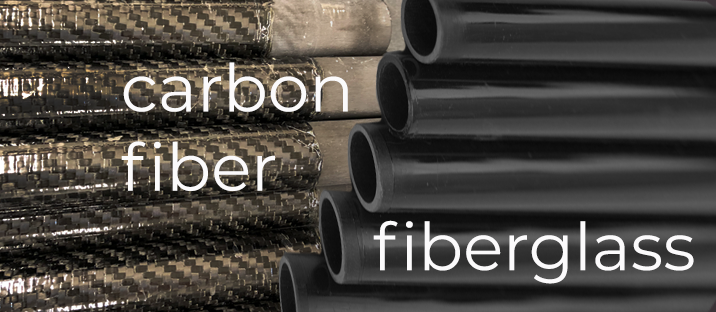
La fibre de carbone est souvent confondue avec la fibre de verre. Even though there are similarities in manufacturing and some crossover in end products like furniture and automobile moldings, ils sont différents.
Fibre de verre vs. fibre de carbone, ce qui est mieux dans l'ensemble? Il est assez difficile de donner une réponse précise à cette question car cela dépend des applications et des propriétés.. Dans certaines régions, par exemple, fabrication aérospatiale, la fibre de carbone surpasse la fibre de verre. Cependant, quand il s'agit d'isolation, la fibre de verre est le choix idéal.
Force
Carbon fiber is renowned for its exceptional strength, which is largely due to its fibrous structure and high tensile strength. It is more than 20% stronger than fiberglass and has a strength-to-weight ratio that is roughly twice as high. Carbon fiber is strong because its fibers are tightly bonded, providing a high level of structural integrity without adding excess weight.
D'autre part, fiberglass is still much stronger than steel, but its strength is more evenly distributed, making it less rigid than carbon fiber. It is less brittle and offers more flexibility, but this trade-off means fiberglass is less suitable for applications where rigidity and strength are critical.
Élasticité
Carbon fiber is much less flexible than fiberglass, with a tensile modulus four times higher. This means carbon fiber is much stiffer and more rigid. En revanche, fiberglass is more elastic, capable of bending and absorbing more strain without breaking, making it more flexible overall.
Poids
Carbon fiber is typically about 15% lighter than fiberglass. This weight difference gives carbon fiber an advantage in applications where minimizing weight is important.
While both materials are lighter than metals like steel and aluminum, fiberglass still offers a favorable weight-to-strength ratio but is relatively heavier compared to carbon fiber.
Résistance à la chaleur
Carbon fiber has a low coefficient of thermal expansion and high dimensional stability, meaning it maintains its mechanical properties in extreme temperatures. Its negative coefficient of thermal expansion is offset by the positive coefficient of its matrix, resulting in a near-neutral overall thermal expansion. This gives carbon fiber better stability in both extreme heat and cold.
En revanche, fiberglass expands with heat and contracts with cold, making it less stable in fluctuating temperatures. Cependant, some specialized fiberglass types can withstand heat up to 7200°C.
Résistance chimique
Both carbon fiber and fiberglass offer excellent resistance to harmful chemicals, corrosion, acids, et abrasion. Cependant, carbon fiber generally performs better in extreme environments, as it is more resistant to a wider range of chemicals. While fiberglass also provides strong chemical resistance, it may not be as effective in certain highly corrosive conditions.
Coût
Fiberglass is generally more cost-effective than carbon fiber due to its simpler manufacturing process and the availability of raw materials. Donc, la fibre de verre est utilisée dans une gamme d'applications plus large que la fibre de carbone.
Il n'est pas facile pour la fibre de carbone de réaliser une production de masse. Il’s more of an intensive and time-consuming process to manufacture carbon fiber than fiber glass. The manufacturing process of carbon fiber should be more organized and involved, et il y a moins de producteurs établis de fibre de carbone.
Common Applications of Carbon Fiber and Fiberglass

Applications en fibre de carbone
Carbon fiber has high electrical conductivity (impédance volumétrique) as well as excellent EMI shielding propriétés. Grâce à ces caractéristiques, CFRP (plastiques renforcés de fibres de carbone) sont appliqués dans le domaine du blindage EMI. CFRP is superior to steel or glass fiber reinforced plastics (PRV) en termes de résistance à la traction spécifique et de module élastique spécifique (rigidité spécifique).
En outre, carbon fiber composites are extensively used in the automotive and aerospace industries, as well as in sports equipment and other high-performance applications where light weight and strength are crucial. The material’s versatility has led to its adoption in a wide range of products, from fishing rods and bicycle frames to high-end autom
Carbon fiber has a strength index, qui est classé en fonction de sa résistance à la traction. Les types courants de fibre de carbone sont le T300, T400, T700, T800, T1000. Les produits du T300 sont principalement destinés à un usage civil ordinaire, et les produits de T800 et supérieurs sont principalement utilisés dans le domaine spatial militaire. Le marché de la fibre de carbone devrait atteindre une valeur supérieure à $8.9 milliards par 2031. Ce chiffre est révélateur de la large utilisation et de la popularité des fibres de carbone..
Fiberglass Applications
Fiber glass is usually used as reinforcement materials, electrical insulation materials and thermal insulation materials when manufacturing composite materials. Une fois les fibres de verre tissées ensemble, différentes résines peuvent être ajoutées pour augmenter la résistance du produit, ce qui lui permet d'être moulé dans une variété de formes.
Différents fabricants produisent différents types de fibres de verre pour différentes utilisations finales. Common items made from fiberglass include home furnishings fabrics, vêtements et vêtements, pneus, équipement sportif, pièces extérieures de voiture. Since fiber glass is lightweight and durable, c'est un matériau idéal pour des applications plus élaborées, tels que les circuits imprimés.
Conclusion
Pour résumer, la fibre de carbone et la fibre de verre présentent des avantages et des inconvénients sous différents aspects. Each type of fibers varies in its properties such as strength, élasticité, poids, résistance à la chaleur, résistance chimique, and cost so different materials can be interchanged in certain aspects of industry depending on the circumstances.
Consumers have to take the properties of steel into their consideration when purchasing. There are many factors to consider when choosing carbon fiber and fiber glass. Sometimes consumers also need to take the manufacturer and supplier into account.
FAQ
How heavy is carbon fiber?
Carbon fiber typically weighs around 1.6–2.0 grams per cubic centimeter (g/cm³). C'est 15-20% lighter than fiberglass, making it an ideal choice for high-strength, lightweight applications.
Is carbon fiber expensive?
Oui, carbon fiber is typically much more expensive than fiberglass, with prices ranging from $10 à $20 per pound, depending on the grade. Its high cost is due to the complex manufacturing process, though its superior strength and light weight often justify the expense in specialized applications.
Which is better, carbon fiber or glass fiber?
It depends on the application. Carbon fiber is stronger, plus léger, and more rigid, making it ideal for high-performance uses, while fiberglass is more affordable and flexible, suitable for cost-effective projects.