
Carbon fiber has become an increasingly popular material in automotive manufacturing, motorsports, аэрокосмический, спортивные товары, and industrial applications. Its combination of low weight, высокая жесткость, and distinctive appearance makes it an attractive choice for manufacturers developing advanced composite products.
Однако, not all carbon fiber parts are manufactured using the same process.
When sourcing carbon fiber components, buyers frequently encounter two terms: dry carbon fiber and wet carbon fiber.
Although both can use genuine carbon fiber reinforcement, their manufacturing methods, material properties, production costs, and potential applications can be significantly different.
For automotive parts distributors, aftermarket brands, and OEM/ODM buyers, understanding these differences is essential when choosing the right manufacturing process.
В этой статье, we explain how dry and wet carbon fiber parts are manufactured, compare their key characteristics, and explore which process may be more suitable for your next project.
1. What Is Dry Carbon Fiber?
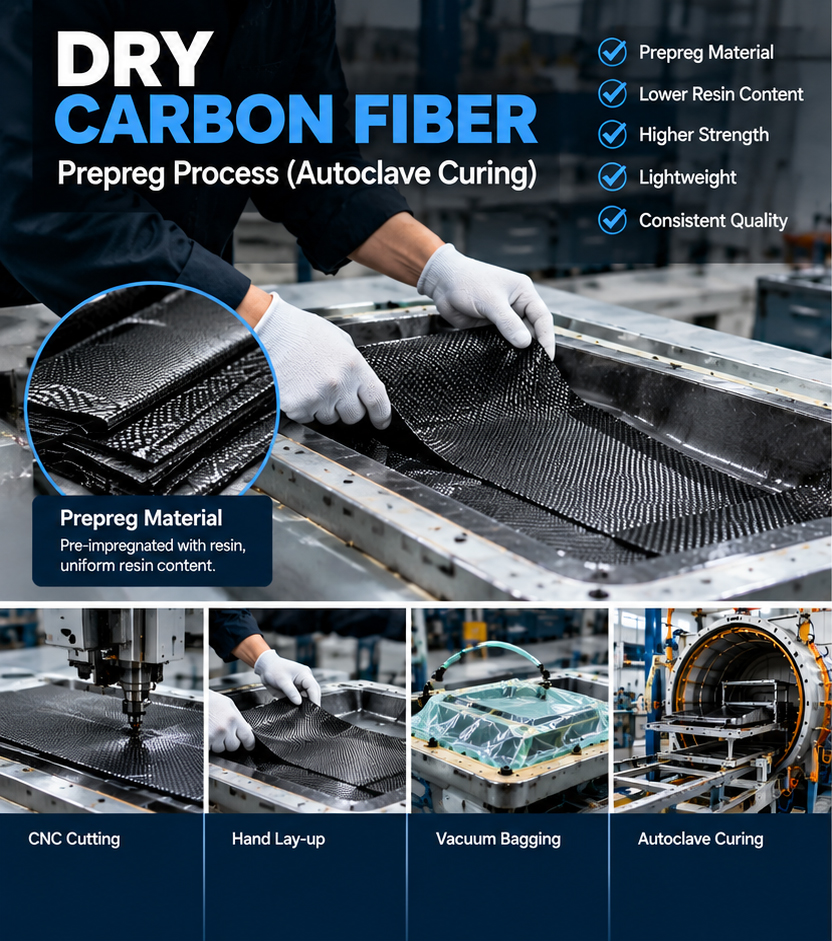
Dry carbon fiber generally refers to carbon fiber components manufactured using pre-impregnated carbon fiber materials, commonly known as prepreg carbon fiber.
Prepreg materials contain carbon fibers that have already been impregnated with a controlled amount of resin.
Unlike traditional wet layup, where liquid resin is applied during manufacturing, prepreg materials arrive with the resin already incorporated into the reinforcement.
In many high-performance manufacturing applications, prepreg carbon fiber is laid into a mold, vacuum bagged, and cured using controlled temperature and pressure.
Autoclave curing is one widely used method, although certain prepreg systems are designed for oven curing or other manufacturing processes.
How Is Dry Carbon Fiber Manufactured?
A typical prepreg carbon fiber manufacturing process includes the following steps:
Шаг 1: Material Preparation
Carbon fiber prepreg is selected according to the required fiber orientation, Плетение рисунка, смоляная система, and product specifications.
Шаг 2: Рутья с ЧПУ
The prepreg material is cut into predetermined shapes to match the mold geometry and laminate design.
Шаг 3: Ручная расстановка
Technicians carefully position the carbon fiber layers inside the mold.
Ориентация волокна, layer placement, and laminate thickness are controlled according to the product requirements.
Шаг 4: Vacuum Bagging
The laminate is sealed inside a vacuum bag to help remove trapped air and consolidate the material during processing.
Шаг 5: Autoclave Curing
For autoclave-compatible prepreg systems, controlled heat and pressure consolidate and cure the laminate.
The specific temperature, давление, and curing time depend on the selected material system.
Шаг 6: Демонтаж и обрезка
После отверждения, the component is removed from the mold and trimmed to its required dimensions.
Шаг 7: Поверхностная отделка
Depending on the application, the product may undergo sanding, покрытие, полировка, or other finishing operations.
Шаг 8: Проверка качества
The finished component is inspected for dimensional accuracy, surface appearance, and other specified quality requirements.
This controlled manufacturing approach is commonly selected for applications where repeatability, weight management, and consistent laminate quality are important.
2. What Is Wet Carbon Fiber?
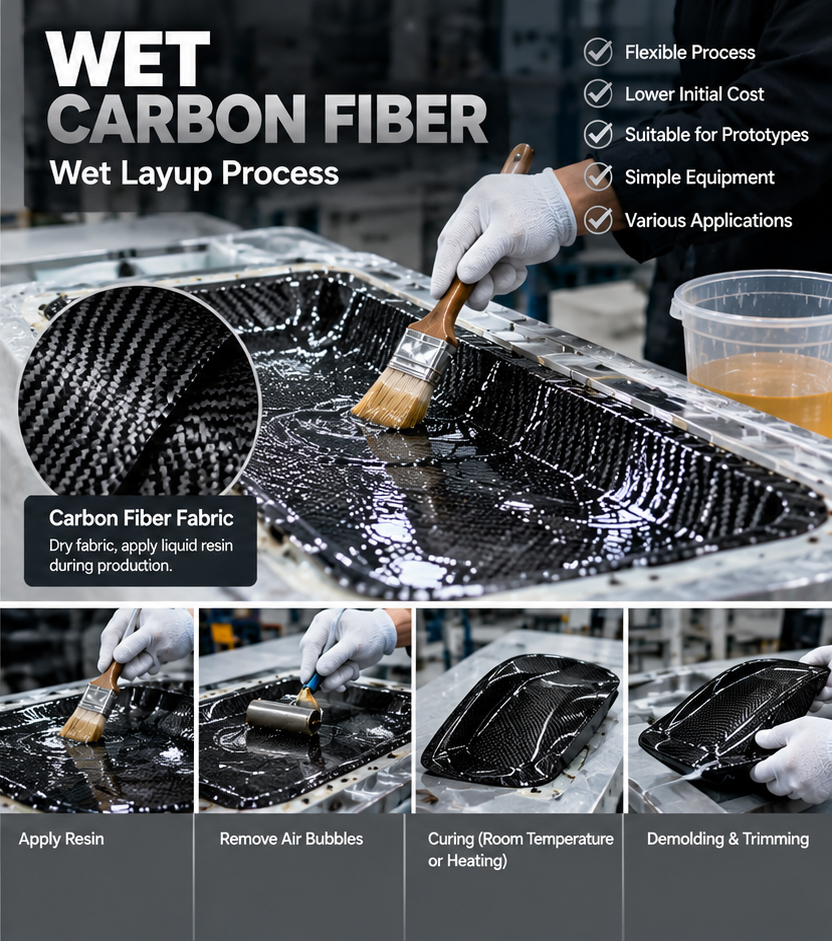
Wet carbon fiber generally refers to components manufactured using a wet layup process.
In this method, сухая ткань из углеродного волокна помещается в форму, and liquid resin is applied during the manufacturing process.
The resin is typically distributed using brushes, rollers, or other suitable tools.
After the carbon fiber fabric is saturated with resin, the laminate is consolidated and allowed to cure.
Depending on the resin system and manufacturing requirements, curing may occur at room temperature or under controlled heating.
How Is Wet Carbon Fiber Manufactured?
The wet layup process typically includes:
- Preparing the mold and applying release materials.
- Cutting dry carbon fiber fabric into the required shapes.
- Positioning carbon fiber layers inside the mold.
- Applying liquid resin to impregnate the reinforcement.
- Removing trapped air and consolidating the laminate.
- Allowing the resin to cure.
- Demolding, trimming, and finishing the component.
Wet layup generally requires less specialized equipment than autoclave-cured prepreg manufacturing.
По этой причине, it is frequently used for prototypes, selected cosmetic components, repairs, and low-volume production.
Однако, the quality of wet layup components depends heavily on material selection, resin application, operator experience, and process control.
It is also important to distinguish manual wet layup from other liquid resin processes, such as vacuum infusion and resin transfer molding, which can offer different levels of process control.
3. Dry Carbon Fiber vs. Wet Carbon Fiber: Ключевые различия
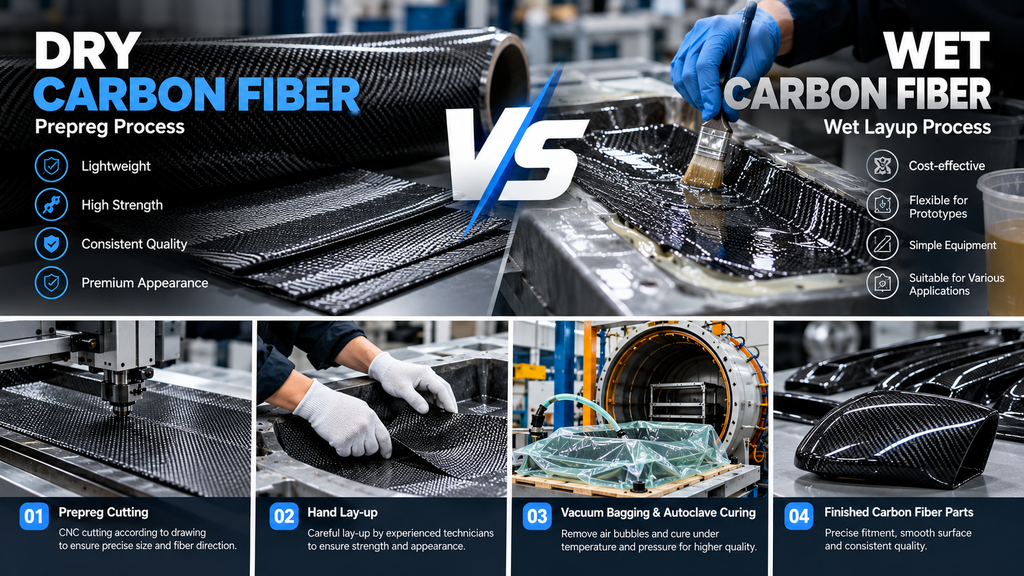
The most important differences between dry and wet carbon fiber involve resin control, manufacturing equipment, laminate consistency, production cost, and achievable performance.
Производственный процесс
Dry carbon fiber commonly uses prepreg materials with controlled resin content.
Wet layup uses dry reinforcement that is impregnated with liquid resin during manufacturing.
Масса
Prepreg manufacturing can provide more consistent control over resin content and fiber volume fraction.
When appropriately designed and processed, this can help produce lightweight components with efficient structural properties.
Wet layup components may contain additional resin, particularly when the impregnation and consolidation processes are less tightly controlled.
Однако, the final weight of either product depends on its design, толщина ламината, материальная система, and manufacturing quality.
Strength and Stiffness
Carbon fiber composite performance depends on several factors, включая:
- Fiber type and orientation.
- Система смолы.
- Fiber volume fraction.
- Laminate thickness.
- Manufacturing defects.
- Curing conditions.
- Component geometry.
Well-controlled prepreg manufacturing can provide excellent mechanical consistency.
Однако, it is not accurate to assume that every dry carbon fiber component is automatically stronger than every wet layup component.
The actual performance must be evaluated according to the finished laminate and its intended application.
Surface Appearance
Both processes can produce visually attractive carbon fiber components.
Prepreg manufacturing offers advantages in controlling material placement and resin content, which can help achieve consistent appearance across repeated production runs.
Wet layup components can also achieve high-quality finishes when properly manufactured and finished.
For visible automotive components, weave alignment, coating quality, and surface consistency are particularly important.
Стоимость производства
Prepreg materials generally involve higher material handling and equipment requirements.
Some systems require refrigerated storage, controlled processing environments, and specialized curing equipment.
Wet layup can offer lower initial equipment costs and greater flexibility for certain low-volume applications.
Однако, the final cost depends on labor, оснастка, finishing, quality requirements, and production quantity.
4. Dry Carbon Fiber vs. Wet Carbon Fiber Comparison Table
FeatureDry Carbon Fiber (Препрег)Wet Carbon Fiber (Мокрая раскладка)Raw materialPre-impregnated carbon fiberDry carbon fiber and liquid resinResin applicationControlled before layupApplied during manufacturingCuring methodControlled curing; autoclave or oven depending on systemRoom-temperature or heated curingResin contentGenerally more consistentMore dependent on application and process controlWeight controlStrong potential for repeatabilityMore variable with manual processingMechanical propertiesExcellent potential with appropriate design and processingCan be suitable for many applicationsSurface qualityHigh-quality finishes achievableHigh-quality finishes also achievableEquipment investmentGenerally higherGenerally lower for basic wet layupProduction costOften higherOften lower for simple applicationsTypical applicationsHigh-performance components and precision composite partsPrototypes, cosmetic parts, repairs, and selected low-volume products
The best manufacturing method depends on the product’s requirements rather than the process name alone.
5. Why Is Dry Carbon Fiber Often More Expensive?
One of the most common questions from buyers is why dry carbon fiber products often cost more than wet carbon fiber alternatives.
There are several reasons.
Higher Material Costs
Prepreg carbon fiber materials undergo additional manufacturing steps before reaching the component manufacturer.
The controlled resin impregnation process contributes to material consistency but also affects material cost.
Specialized Equipment
Prepreg manufacturing may require refrigerated material storage, vacuum equipment, controlled curing systems, and specialized tooling.
Autoclave processing also involves equipment investment, обслуживание, потребление энергии, и планирование производства.
Skilled Manufacturing Labor
Complex carbon fiber components require careful material cutting, ориентация волокна, mold preparation, простоя, and finishing.
The labor requirements can be significant, particularly for components with complicated shapes.
Quality Control Requirements
Customers purchasing high-performance or precision components may require detailed inspection procedures, dimensional verification, and controlled production records.
These additional requirements can influence manufacturing costs.
Production Volume
Small-batch custom projects may involve relatively high unit costs because tooling, development, and setup expenses are distributed across fewer products.
Для B2B-покупателей, evaluating tooling costs separately from unit prices is often helpful when planning a new product.
6. Which Carbon Fiber Process Is Better for Automotive Parts?
Both dry and wet carbon fiber manufacturing can be used in the automotive industry.
The most suitable method depends on the component’s function, appearance requirements, expected production quantity, и бюджет.
Automotive Interior Trim
Carbon fiber interior components may include:
- Center console trim.
- Dashboard decorative panels.
- Door trim.
- Steering wheel decorative covers.
- Gear shift surrounds.
- Interior accessory panels.
For premium interior trim products, buyers often prioritize consistent weave patterns, точная посадка, and high-quality surface finishes.
Prepreg manufacturing can be an attractive option when these requirements are important.
Automotive Exterior Components
Carbon fiber exterior applications may include:
- Передние губы.
- Rear spoilers.
- Накладки на зеркала.
- Exterior trim panels.
- Диффузоры.
- Selected body panels.
For these products, manufacturers must consider geometry, точки крепления, environmental exposure, and the intended operating conditions.
Visible exterior components may also require suitable coatings to protect the resin system and maintain the desired appearance.
Performance-Oriented Components
Some performance applications require carefully engineered composite structures.
In these cases, ориентация волокна, дизайн ламината, material properties, and manufacturing quality must be evaluated together.
Structural components should be designed and validated for their intended loads and operating conditions.
A carbon fiber appearance alone does not establish structural suitability.
7. How to Identify High-Quality Carbon Fiber Parts
When purchasing carbon fiber components, appearance is important, but it should not be the only evaluation criterion.
Here are several factors B2B buyers should consider.
Check the Carbon Fiber Weave
For visible carbon fiber components, inspect whether the weave pattern meets the agreed appearance standard.
Complex curves can affect how the fabric pattern appears, so reference samples are useful when establishing cosmetic expectations.
Inspect the Surface Finish
Look for visible defects such as:
- Pinholes.
- Surface bubbles.
- Scratches.
- Uneven coating.
- Resin-rich areas.
- Poorly finished edges.
The acceptance criteria should be defined according to the product’s intended use.
Verify Dimensions and Fitment
Automotive components must match the relevant vehicle application.
Check critical dimensions, монтажные отверстия, clips, and other installation interfaces.
Whenever possible, conduct physical fitment testing before approving mass production.
Ask About Manufacturing Methods
A reliable supplier should be able to explain the manufacturing process used for the product.
Buyers can ask whether the component is manufactured using prepreg, manual wet layup, вакуумная инфузия, or another composite process.
Request Samples Before Bulk Orders
For custom products, sample approval helps establish clear expectations for appearance, размеры, material selection, и качество отделки.
An approved sample can also serve as a reference for future production batches.
8. Why Choose Prepreg Carbon Fiber for OEM/ODM Projects?
Для брендов, дистрибьюторы, and manufacturers developing customized carbon fiber products, prepreg manufacturing offers several potential advantages.
Consistent Material Preparation
Prepreg materials provide controlled resin content, supporting repeatable manufacturing when handled and processed correctly.
Flexible Product Development
Carbon fiber components can be developed in different shapes and configurations using suitable molds and laminate designs.
Appearance Customization
Depending on material availability and manufacturing feasibility, products may be developed with different weave patterns, цвета, and surface finishes.
Controlled Production
Defined material specifications, layup procedures, curing parameters, and inspection requirements can help maintain production consistency.
Long-Term Supply Cooperation
For B2B customers, a manufacturer capable of repeat production can support product development, inventory planning, and ongoing purchasing requirements.
Однако, prepreg is not automatically the most economical choice for every project.
A technical feasibility review is important before selecting the manufacturing method.
9. Custom Dry Carbon Fiber Manufacturing at Shasha Carbon
и Шаша Карбон, we focus on the development and manufacturing of customized carbon fiber components for business customers.
Our manufacturing capabilities include prepreg material preparation, Рутья с ЧПУ, hand layup, vacuum bagging, автоклавное отверждение, trimming, отделка поверхности, и проверка качества.
We support OEM/ODM projects based on customer-provided physical samples, technical drawings, and 3D models, subject to project feasibility.
Our manufacturing services cover automotive interior and exterior components as well as selected carbon fiber housings, shells, and other customized composite parts for different industries.
Our Custom Manufacturing Services
OEM/ODM Development
We work with business customers to evaluate product requirements and develop manufacturing solutions.
Разработка пресс-форм
Custom molds can be developed according to approved product designs or suitable physical samples.
Material and Appearance Options
Available options may include different carbon fiber weave patterns, цвета, and matte or glossy finishes.
Sample Development
Prototype and sample production help customers verify the product before placing larger orders.
Batch Manufacturing
После утверждения образца, production can proceed according to the agreed specifications and quality requirements.
Our services are primarily intended for businesses, дистрибьюторы, brands, and manufacturers requiring product development or batch manufacturing rather than individual one-piece customization.
10. How to Start a Custom Carbon Fiber Project
If you are planning to develop a carbon fiber product, preparing the following information can help streamline the quotation process:
- Product name and intended application.
- Physical sample, technical drawing, or 3D model.
- Required dimensions and critical tolerances.
- Preferred carbon fiber material and surface finish.
- Estimated initial order quantity.
- Expected annual purchasing volume, если доступно.
- Packaging or branding requirements.
- Target development and delivery schedule.
For projects requiring new molds, tooling development costs and sample production requirements should be discussed before mass production.
Часто задаваемые вопросы
Is dry carbon fiber stronger than wet carbon fiber?
Prepreg manufacturing can provide more consistent resin content and laminate quality, which may support better mechanical performance. Однако, strength depends on the complete laminate design, materials, curing process, and manufacturing quality.
Is dry carbon fiber lighter?
Prepreg manufacturing can help control resin content and reduce unnecessary material weight. Nevertheless, the final component weight depends on its geometry, толщина, and structural requirements.
Does dry carbon fiber always require an autoclave?
Нет. Some prepreg materials are designed for out-of-autoclave curing. The required curing method depends on the resin system and material specifications.
Is wet carbon fiber real carbon fiber?
Да. Wet layup can use genuine carbon fiber reinforcement. The term describes the manufacturing process rather than whether the carbon fiber itself is authentic.
Which process is better for custom automotive parts?
The answer depends on the product’s function, required appearance, mechanical performance, order quantity, и бюджет. Prepreg manufacturing is often attractive for premium components requiring controlled laminate quality, while wet layup may be suitable for other applications.
Can I develop custom carbon fiber parts without an existing mold?
Да. В зависимости от проекта, a manufacturer may develop new tooling using technical drawings, 3модели D, or physical samples.
Заключение
Understanding the differences between dry and wet carbon fiber is important when sourcing composite components.
Prepreg manufacturing offers advantages in resin control, process consistency, and the potential for high-performance laminate production.
Wet layup remains a practical manufacturing option for many applications, particularly where production flexibility and initial equipment costs are important.
Neither method should be selected based on appearance or price alone.
For OEM buyers, дистрибьюторы, and product developers, the most important factors are manufacturing suitability, качество продукции, точность размеров, and long-term production consistency.
Looking for a reliable custom carbon fiber manufacturer?
Shasha Carbon supports business customers with carbon fiber mold development, sample production, and OEM/ODM manufacturing.
Whether you are developing automotive components or carbon fiber parts for another industry, our team can help evaluate your project requirements.
Contact Shasha Carbon today and send us your product drawings, 3D-файлы, or physical sample information to discuss your custom manufacturing project.


