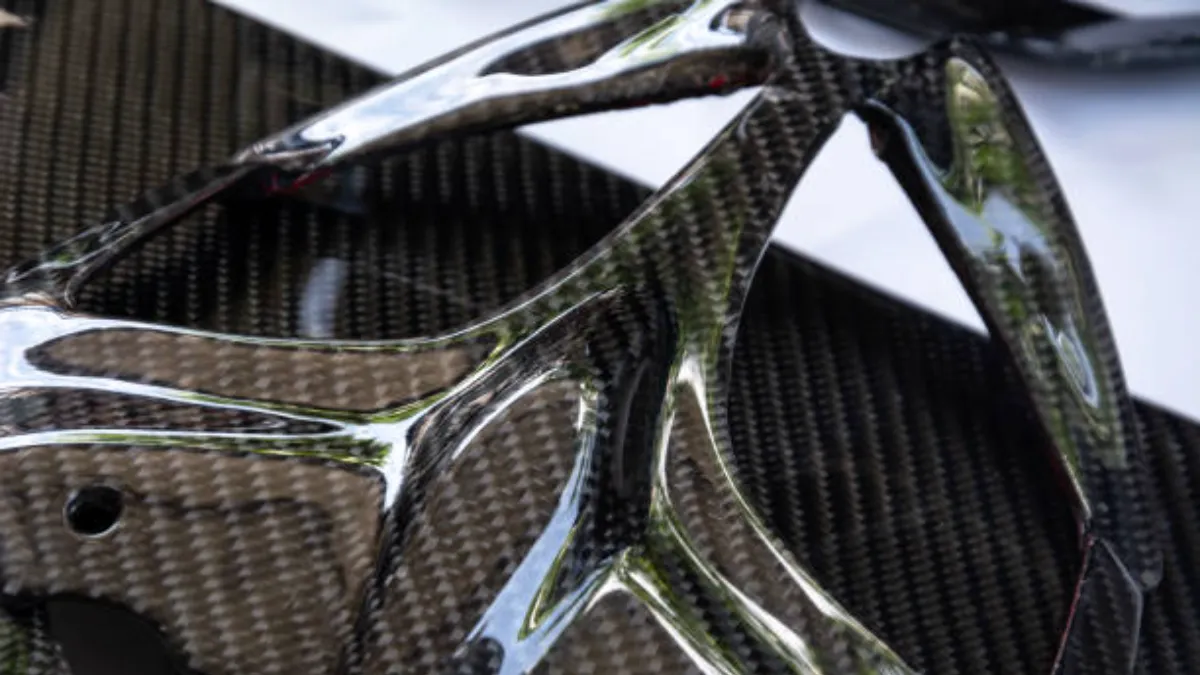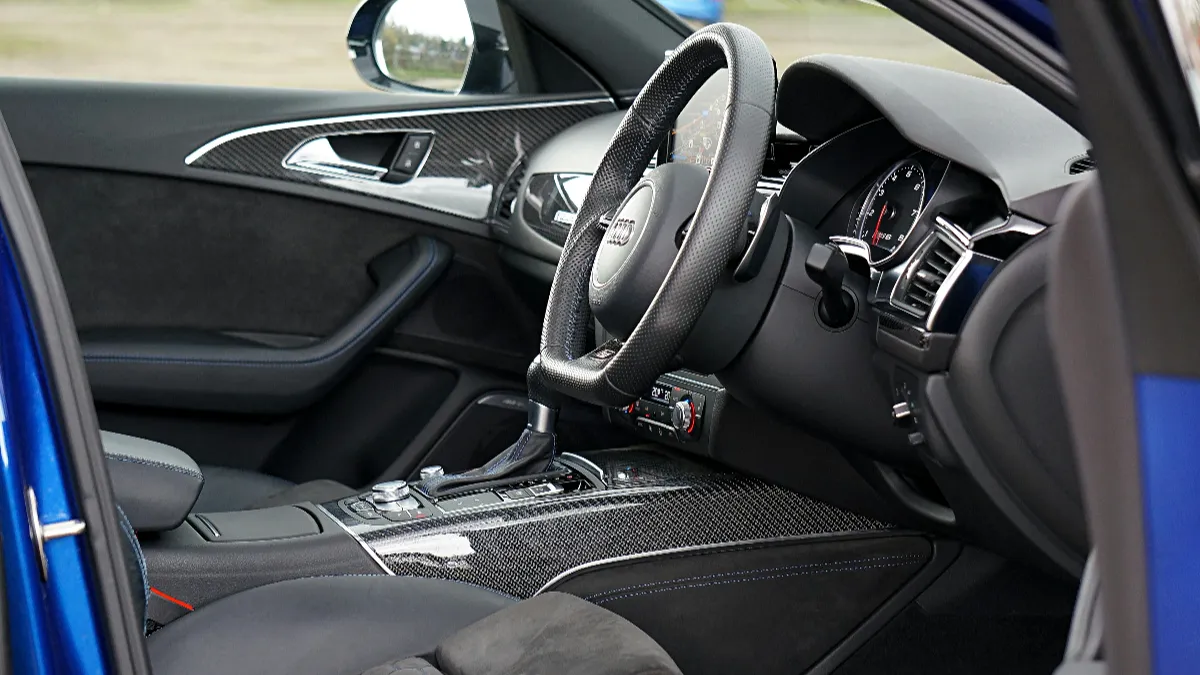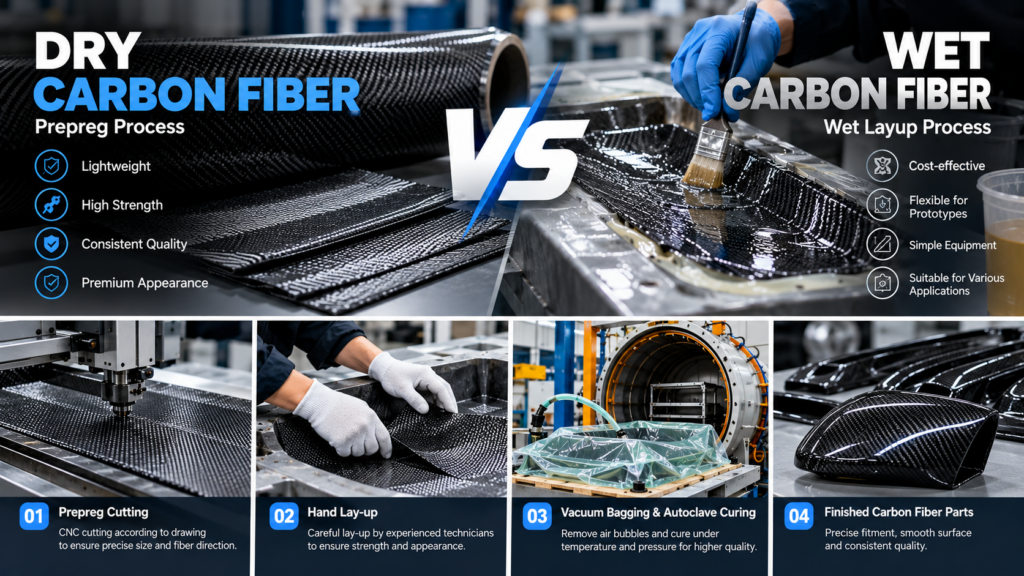
{"id":13977,"date":"2025-09-28T11:07:00","date_gmt":"2025-09-28T11:07:00","guid":{"rendered":"https:\/\/shashacarbon.com\/?p=13977"},"modified":"2025-09-29T01:24:24","modified_gmt":"2025-09-29T01:24:24","slug":"types-of-carbon-fiber","status":"publish","type":"post","link":"https:\/\/shashacarbon.com\/de\/types-of-carbon-fiber\/","title":{"rendered":"Exploring the Different Types of Carbon Fiber Materials"},"content":{"rendered":"<p>Carbon fiber is a high-performance material prized for its strength, light weight, and versatility and is widely used in industries like automotive, aerospace, and high-performance sports equipment.<\/p>\n\n\n\n<p>In this article, we will explore the different types of carbon fiber materials, their characteristics, common weaves, applications, and tips for choosing the right type for your project.<\/p>\n\n\n\n<div style=\"height:100px\" aria-hidden=\"true\" class=\"wp-block-spacer\"><\/div>\n\n\n\n<h2 class=\"wp-block-heading\"><strong>What Is Carbon Fiber and How Is It Made?<\/strong><strong><\/strong><\/h2>\n\n\n\n<figure class=\"wp-block-image size-large\"><img fetchpriority=\"high\" decoding=\"async\" width=\"1024\" height=\"576\" src=\"https:\/\/shashacarbon.com\/wp-content\/uploads\/2025\/09\/carbon-fiber-plain-weave-1024x576.webp\" alt=\"carbon fiber plain weave\" class=\"wp-image-13979\" srcset=\"https:\/\/shashacarbon.com\/wp-content\/uploads\/2025\/09\/carbon-fiber-plain-weave-1024x576.webp 1024w, https:\/\/shashacarbon.com\/wp-content\/uploads\/2025\/09\/carbon-fiber-plain-weave-300x169.webp 300w, https:\/\/shashacarbon.com\/wp-content\/uploads\/2025\/09\/carbon-fiber-plain-weave-768x432.webp 768w, https:\/\/shashacarbon.com\/wp-content\/uploads\/2025\/09\/carbon-fiber-plain-weave-18x10.webp 18w, https:\/\/shashacarbon.com\/wp-content\/uploads\/2025\/09\/carbon-fiber-plain-weave-600x338.webp 600w, https:\/\/shashacarbon.com\/wp-content\/uploads\/2025\/09\/carbon-fiber-plain-weave.webp 1200w\" sizes=\"(max-width: 1024px) 100vw, 1024px\" \/><\/figure>\n\n\n\n<p><a href=\"https:\/\/shashacarbon.com\/de\/what-is-carbon-fiber-material\/\">Kohlefaser<\/a> is a material made of very thin filaments of carbon atoms. It has a fiber structure but combines the advantages of metals and non-metals: it is strong and stiff like steel, yet lightweight, corrosion-resistant, and thermally stable. Because of these properties, carbon fiber is widely used in automotive parts, aerospace components, and high-performance sports equipment, where both strength and low weight are critical.<\/p>\n\n\n\n<p>Its production involves several key steps that determine the final fiber\u2019s strength and stiffness.<\/p>\n\n\n\n<ol class=\"wp-block-list\">\n<li><strong>Precursor Preparation<\/strong>: The starting material, usually PAN (polyacrylonitrile), pitch, or rayon, is spun into thin filaments. The choice of precursor affects the fiber&#8217;s final stiffness and strength.<\/li>\n\n\n\n<li><strong>Stabilization and Carbonization<\/strong>: Fibers are oxidized at moderate temperatures and then heated to very high temperatures in an inert atmosphere. This process drives off non-carbon atoms and aligns the carbon chains, enhancing strength and rigidity.<\/li>\n\n\n\n<li><strong>Optional Graphitization and Surface Treatment<\/strong>: Some fibers undergo graphitization for additional stiffness, and surface treatments improve bonding with resin matrices in composites.<\/li>\n<\/ol>\n\n\n\n<div style=\"height:100px\" aria-hidden=\"true\" class=\"wp-block-spacer\"><\/div>\n\n\n\n<h2 class=\"wp-block-heading\"><strong>Different Types of Carbon Fiber Materials<\/strong><strong><\/strong><\/h2>\n\n\n<div class=\"wp-block-image\">\n<figure class=\"aligncenter size-full is-resized\"><img decoding=\"async\" width=\"675\" height=\"675\" src=\"https:\/\/shashacarbon.com\/wp-content\/uploads\/2025\/09\/types-of-carbon-fiber-5.webp\" alt=\"types of carbon fiber 5\" class=\"wp-image-13984\" style=\"width:467px;height:auto\" srcset=\"https:\/\/shashacarbon.com\/wp-content\/uploads\/2025\/09\/types-of-carbon-fiber-5.webp 675w, https:\/\/shashacarbon.com\/wp-content\/uploads\/2025\/09\/types-of-carbon-fiber-5-300x300.webp 300w, https:\/\/shashacarbon.com\/wp-content\/uploads\/2025\/09\/types-of-carbon-fiber-5-150x150.webp 150w, https:\/\/shashacarbon.com\/wp-content\/uploads\/2025\/09\/types-of-carbon-fiber-5-12x12.webp 12w, https:\/\/shashacarbon.com\/wp-content\/uploads\/2025\/09\/types-of-carbon-fiber-5-600x600.webp 600w\" sizes=\"(max-width: 675px) 100vw, 675px\" \/><\/figure>\n<\/div>\n\n\n<p>Carbon fiber can be categorized in several ways depending on the aspect you focus on. Here are the most common classifications.<\/p>\n\n\n\n<div style=\"height:30px\" aria-hidden=\"true\" class=\"wp-block-spacer\"><\/div>\n\n\n\n<h3 class=\"wp-block-heading\"><strong>Types Based on Raw Materials<\/strong><strong><\/strong><\/h3>\n\n\n\n<p>The raw material used in carbon fiber production heavily influences its properties:<\/p>\n\n\n\n<ul class=\"wp-block-list\">\n<li><strong>PAN-Based Carbon Fiber<\/strong>: Derived from polyacrylonitrile, this type is highly versatile and widely used in automotive and aerospace applications. It offers excellent strength-to-weight ratios and good fatigue resistance.<\/li>\n\n\n\n<li><strong>Pitch-Based Carbon Fiber<\/strong>: Made from petroleum or coal pitch, it has a very high modulus and is ideal for applications requiring extreme stiffness, like satellite structures.<\/li>\n\n\n\n<li><strong>Rayon-Based Carbon Fiber<\/strong>: An older precursor type, less common today, usually found in applications requiring moderate strength and flexibility.<\/li>\n<\/ul>\n\n\n\n<div style=\"height:30px\" aria-hidden=\"true\" class=\"wp-block-spacer\"><\/div>\n\n\n\n<h3 class=\"wp-block-heading\"><strong>Types Based on Mechanical Properties<\/strong><strong><\/strong><\/h3>\n\n\n\n<p>Carbon fibers can be classified by their modulus of elasticity, which measures stiffness in GPa, and tensile strength, which measures strength in MPa.<\/p>\n\n\n\n<ul class=\"wp-block-list\">\n<li><strong>Standard Modulus (SM)<\/strong>: Elastic modulus around 200\u2013280 GPa and tensile strength approximately 2,500 MPa. SM fibers are strong yet relatively flexible, offering good performance at a lower cost. They are commonly used in general automotive panels, sporting goods, and consumer products.<\/li>\n\n\n\n<li><strong>Intermediate Modulus (IM)<\/strong>: Elastic modulus about 280\u2013350 GPa with tensile strength near 3,500 MPa. IM fibers provide a balanced combination of stiffness and strength, making them ideal for racing car panels, aircraft interior structures, and moderate-load structural components.<\/li>\n\n\n\n<li><strong>High Modulus (HM)<\/strong>: Elastic modulus between 350\u2013600 GPa and tensile strength around 2,500 MPa. HM fibers deliver high stiffness with reduced elongation, suitable for aerospace parts, high-performance automotive reinforcements, and applications requiring dimensional stability.<\/li>\n\n\n\n<li><strong>Ultra-High Modulus (UHM)<\/strong>: Elastic modulus exceeds 600 GPa, with tensile strength above 2,500 MPa. UHM fibers are extremely rigid and lightweight, often used in advanced aerospace structures, satellite components, and precision engineering.<\/li>\n<\/ul>\n\n\n\n<div style=\"height:30px\" aria-hidden=\"true\" class=\"wp-block-spacer\"><\/div>\n\n\n\n<h3 class=\"wp-block-heading\"><strong>Types Based on Fiber Forms<\/strong><strong><\/strong><\/h3>\n\n\n\n<p>Carbon fibers are supplied in various forms, which influence manufacturing flexibility:<\/p>\n\n\n\n<ul class=\"wp-block-list\">\n<li><strong>Continuous Fiber<\/strong>: Long fibers that provide maximum strength in a single direction. Often used in <strong>prepregs<\/strong> for molded parts.<\/li>\n\n\n\n<li><strong>Chopped Fiber<\/strong>: Short strands, easier to mold into complex shapes, suitable for injection-molded or compression-molded parts.<\/li>\n\n\n\n<li><strong>Fabric\/Tow<\/strong>: Woven or bundled fibers that can be layered to create sheets. Fabrics offer uniform strength and aesthetic appeal.<\/li>\n<\/ul>\n\n\n\n<div style=\"height:30px\" aria-hidden=\"true\" class=\"wp-block-spacer\"><\/div>\n\n\n\n<h3 class=\"wp-block-heading\"><strong>Types Based on Composite Forms<\/strong><strong><\/strong><\/h3>\n\n\n\n<p>Once fibers are processed, they can form different composite materials:<\/p>\n\n\n\n<ul class=\"wp-block-list\">\n<li><strong>Prepreg<\/strong>: Carbon fibers pre-impregnated with resin. These sheets are ready to mold and offer excellent fiber-resin ratio control, leading to high-performance parts.<\/li>\n\n\n\n<li><strong>Dry Fabric<\/strong>: Sold without resin, often used in vacuum-assisted resin transfer molding (VARTM).<\/li>\n\n\n\n<li><strong>Forged Carbon<\/strong>: Chopped fibers compressed into a mold with resin. Produces a unique marbled texture, commonly used in automotive interior trims and small panels.<\/li>\n<\/ul>\n\n\n\n<div style=\"height:30px\" aria-hidden=\"true\" class=\"wp-block-spacer\"><\/div>\n\n\n\n<h3 class=\"wp-block-heading\"><strong>Types Based on Final Heat Treatment Temperature<\/strong><strong><\/strong><\/h3>\n\n\n\n<p>Heat treatment significantly affects the fiber&#8217;s final properties:<\/p>\n\n\n\n<ul class=\"wp-block-list\">\n<li><strong>High-heat-treatment Carbon Fibers (HTT)<\/strong>: Final heat treatment temperature exceeds 2000\u00b0C. These fibers exhibit high stiffness and thermal stability, making them suitable for applications requiring superior dimensional stability under heat.<\/li>\n\n\n\n<li><strong>Intermediate-heat-treatment Carbon Fibers (IHT)<\/strong>: Final heat treatment temperature is around 1500\u00b0C. IHT fibers offer a balance of strength and stiffness, providing good performance for structural components.<\/li>\n\n\n\n<li><strong>Low-heat-treatment Carbon Fibers (LHT)<\/strong>: Final heat treatment temperature does not exceed 1000\u00b0C. LHT fibers are more flexible and slightly less stiff but remain strong, suitable for applications where moderate performance and lower production cost are priorities.<\/li>\n<\/ul>\n\n\n\n<div style=\"height:100px\" aria-hidden=\"true\" class=\"wp-block-spacer\"><\/div>\n\n\n\n<h2 class=\"wp-block-heading\"><strong>Common Types of Carbon Fiber Weaves<\/strong><strong><\/strong><\/h2>\n\n\n\n<p>Carbon fiber weaves start from carbon fiber tows, which are bundles of thousands of individual filaments. The \u201ck\u201d value of a tow indicates the number of filaments in the bundle, such as 3k (3,000 filaments) or 12k (12,000 filaments). Different weaves are created by arranging these tows in specific patterns, affecting both performance and appearance.<\/p>\n\n\n\n<div style=\"height:30px\" aria-hidden=\"true\" class=\"wp-block-spacer\"><\/div>\n\n\n\n<h3 class=\"wp-block-heading\"><strong>Leinwandbindung<\/strong><strong><\/strong><\/h3>\n\n\n\n<figure class=\"wp-block-image size-large\"><img decoding=\"async\" width=\"1024\" height=\"576\" src=\"https:\/\/shashacarbon.com\/wp-content\/uploads\/2025\/09\/carbon-fiber-plain-weave-2-1024x576.webp\" alt=\"carbon fiber plain weave 2\" class=\"wp-image-13978\" srcset=\"https:\/\/shashacarbon.com\/wp-content\/uploads\/2025\/09\/carbon-fiber-plain-weave-2-1024x576.webp 1024w, https:\/\/shashacarbon.com\/wp-content\/uploads\/2025\/09\/carbon-fiber-plain-weave-2-300x169.webp 300w, https:\/\/shashacarbon.com\/wp-content\/uploads\/2025\/09\/carbon-fiber-plain-weave-2-768x432.webp 768w, https:\/\/shashacarbon.com\/wp-content\/uploads\/2025\/09\/carbon-fiber-plain-weave-2-18x10.webp 18w, https:\/\/shashacarbon.com\/wp-content\/uploads\/2025\/09\/carbon-fiber-plain-weave-2-600x338.webp 600w, https:\/\/shashacarbon.com\/wp-content\/uploads\/2025\/09\/carbon-fiber-plain-weave-2.webp 1200w\" sizes=\"(max-width: 1024px) 100vw, 1024px\" \/><\/figure>\n\n\n\n<p>Plain weave features fibers crossing over each other alternately, creating a simple crisscross pattern like a checkerboard. This weave offers uniform strength in multiple directions and excellent stability during molding. It is relatively easy to handle and provides good dimensional accuracy, making it a common choice for flat or moderately curved surfaces.<\/p>\n\n\n\n<div style=\"height:30px\" aria-hidden=\"true\" class=\"wp-block-spacer\"><\/div>\n\n\n\n<h3 class=\"wp-block-heading\"><strong>K\u00f6perbindung<\/strong><strong><\/strong><\/h3>\n\n\n\n<figure class=\"wp-block-image size-large\"><img loading=\"lazy\" decoding=\"async\" width=\"1024\" height=\"576\" src=\"https:\/\/shashacarbon.com\/wp-content\/uploads\/2025\/09\/carbon-fiber-twill-weave-1024x576.webp\" alt=\"carbon fiber twill weave\" class=\"wp-image-13980\" srcset=\"https:\/\/shashacarbon.com\/wp-content\/uploads\/2025\/09\/carbon-fiber-twill-weave-1024x576.webp 1024w, https:\/\/shashacarbon.com\/wp-content\/uploads\/2025\/09\/carbon-fiber-twill-weave-300x169.webp 300w, https:\/\/shashacarbon.com\/wp-content\/uploads\/2025\/09\/carbon-fiber-twill-weave-768x432.webp 768w, https:\/\/shashacarbon.com\/wp-content\/uploads\/2025\/09\/carbon-fiber-twill-weave-18x10.webp 18w, https:\/\/shashacarbon.com\/wp-content\/uploads\/2025\/09\/carbon-fiber-twill-weave-600x338.webp 600w, https:\/\/shashacarbon.com\/wp-content\/uploads\/2025\/09\/carbon-fiber-twill-weave.webp 1200w\" sizes=\"(max-width: 1024px) 100vw, 1024px\" \/><\/figure>\n\n\n\n<p>Twill weave is characterized by a diagonal pattern, where fibers pass over one or more fibers before going under one. This pattern offers better drapability than plain weave, allowing it to conform to complex shapes. Twill weave also provides an aesthetically appealing surface with a classic carbon fiber look, which is why it is widely used in automotive exterior and interior panels.<\/p>\n\n\n\n<div style=\"height:30px\" aria-hidden=\"true\" class=\"wp-block-spacer\"><\/div>\n\n\n\n<h3 class=\"wp-block-heading\"><strong>Satinbindung<\/strong><strong><\/strong><\/h3>\n\n\n\n<p>Satin weave has long floats where fibers pass over multiple fibers before going under one. This creates a smooth, glossy surface and allows for excellent drapability over complex curves. Satin weave fibers exhibit high tensile strength along the primary direction and are often chosen for high-end parts requiring both performance and a polished finish.<\/p>\n\n\n\n<div style=\"height:100px\" aria-hidden=\"true\" class=\"wp-block-spacer\"><\/div>\n\n\n\n<h2 class=\"wp-block-heading\"><strong>Applications of Different Types of Carbon Fiber<\/strong><strong><\/strong><\/h2>\n\n\n\n<figure class=\"wp-block-image size-large\"><img loading=\"lazy\" decoding=\"async\" width=\"1024\" height=\"576\" src=\"https:\/\/shashacarbon.com\/wp-content\/uploads\/2025\/09\/types-of-carbon-fiber-3-1024x576.webp\" alt=\"types of carbon fiber 3\" class=\"wp-image-13982\" srcset=\"https:\/\/shashacarbon.com\/wp-content\/uploads\/2025\/09\/types-of-carbon-fiber-3-1024x576.webp 1024w, https:\/\/shashacarbon.com\/wp-content\/uploads\/2025\/09\/types-of-carbon-fiber-3-300x169.webp 300w, https:\/\/shashacarbon.com\/wp-content\/uploads\/2025\/09\/types-of-carbon-fiber-3-768x432.webp 768w, https:\/\/shashacarbon.com\/wp-content\/uploads\/2025\/09\/types-of-carbon-fiber-3-18x10.webp 18w, https:\/\/shashacarbon.com\/wp-content\/uploads\/2025\/09\/types-of-carbon-fiber-3-600x338.webp 600w, https:\/\/shashacarbon.com\/wp-content\/uploads\/2025\/09\/types-of-carbon-fiber-3.webp 1200w\" sizes=\"(max-width: 1024px) 100vw, 1024px\" \/><\/figure>\n\n\n\n<p>The unique advantages of carbon fiber have enabled it to find numerous advanced applications across multiple industries. This following section highlights the main applications:<\/p>\n\n\n\n<p>In the <strong>automotive industry<\/strong>, carbon fiber is used for <a href=\"https:\/\/shashacarbon.com\/de\/products_category\/carbon-fiber-exterior\/\">exterior components<\/a> like hoods, fenders, and spoilers, as well as interior trims, dashboards, and seat frames. <\/p>\n\n\n\n<p>In <strong>aerospace<\/strong>, carbon fiber is used for fuselage panels, wing spars, propellers, and satellite structures. Its lightweight and stiffness allow aircraft and spacecraft to achieve higher efficiency and payload capacity while maintaining structural integrity.<\/p>\n\n\n\n<p>In <strong>sports and leisure equipment<\/strong>, carbon fiber is applied in bicycle frames, tennis rackets, golf clubs, fishing rods, and racing boats. The material provides high performance while keeping the equipment light and durable.<\/p>\n\n\n\n<p>Other <strong>industrial and engineering applications<\/strong> include wind turbine blades, robotic arms, high-pressure vessels, and structural supports for precision instruments. Carbon fiber\u2019s thermal stability and corrosion resistance make it ideal for these demanding environments.<\/p>\n\n\n\n<div style=\"height:100px\" aria-hidden=\"true\" class=\"wp-block-spacer\"><\/div>\n\n\n\n<h2 class=\"wp-block-heading\"><strong>How to Choose the Right Type of Carbon Fiber for Your Project<\/strong><strong><\/strong><\/h2>\n\n\n\n<figure class=\"wp-block-image size-large\"><img loading=\"lazy\" decoding=\"async\" width=\"1024\" height=\"576\" src=\"https:\/\/shashacarbon.com\/wp-content\/uploads\/2025\/09\/types-of-carbon-fiber-steering-wheel-1024x576.webp\" alt=\"types of carbon fiber steering wheel\" class=\"wp-image-13986\" srcset=\"https:\/\/shashacarbon.com\/wp-content\/uploads\/2025\/09\/types-of-carbon-fiber-steering-wheel-1024x576.webp 1024w, https:\/\/shashacarbon.com\/wp-content\/uploads\/2025\/09\/types-of-carbon-fiber-steering-wheel-300x169.webp 300w, https:\/\/shashacarbon.com\/wp-content\/uploads\/2025\/09\/types-of-carbon-fiber-steering-wheel-768x432.webp 768w, https:\/\/shashacarbon.com\/wp-content\/uploads\/2025\/09\/types-of-carbon-fiber-steering-wheel-18x10.webp 18w, https:\/\/shashacarbon.com\/wp-content\/uploads\/2025\/09\/types-of-carbon-fiber-steering-wheel-600x338.webp 600w, https:\/\/shashacarbon.com\/wp-content\/uploads\/2025\/09\/types-of-carbon-fiber-steering-wheel.webp 1200w\" sizes=\"(max-width: 1024px) 100vw, 1024px\" \/><\/figure>\n\n\n\n<p>Selecting the appropriate type of carbon fiber is essential to ensure optimal performance, durability, and cost-efficiency. Several key factors should guide this decision:<\/p>\n\n\n\n<ul class=\"wp-block-list\">\n<li><strong>Mechanical Requirements<\/strong>: Consider the required strength, stiffness, and elasticity. High-modulus or ultra-high-modulus fibers are suitable for applications needing maximum stiffness, while standard or intermediate modulus fibers are adequate for moderate loads.<\/li>\n\n\n\n<li><strong>Weight Considerations<\/strong>: Carbon fiber\u2019s lightweight nature is a primary advantage. Evaluate whether minimizing mass is critical for your project, such as in automotive, aerospace, or sports equipment applications.<\/li>\n\n\n\n<li><strong>Thermal Stability<\/strong>: The operating temperature range of the final product is important. Fibers treated at higher heat levels offer better thermal stability and dimensional consistency under heat.<\/li>\n\n\n\n<li><strong>Weave and Form<\/strong>: The type of weave or composite form affects both mechanical performance and manufacturability. Plain weaves offer stability, twill weaves improve drapability, and prepregs can simplify production for complex shapes.<\/li>\n\n\n\n<li><strong>Cost and Availability<\/strong>: Balance performance requirements with budget constraints. High-modulus or ultra-high-heat-treatment fibers are more expensive, so consider whether their benefits justify the cost.<\/li>\n<\/ul>\n\n\n\n<div style=\"height:100px\" aria-hidden=\"true\" class=\"wp-block-spacer\"><\/div>\n\n\n\n<h2 class=\"wp-block-heading\"><strong>Final Thoughts<\/strong><strong><\/strong><\/h2>\n\n\n\n<p>If you are looking for a <a href=\"https:\/\/shashacarbon.com\/de\">reliable carbon fiber car parts manufacturer<\/a>, partnering with an experienced supplier like Shasha Carbon Fiber ensures access to premium materials, expert guidance, and a range of customizable solutions for automotive applications.<\/p>\n\n\n\n<p><a href=\"https:\/\/shashacarbon.com\/de\/contact-us\/\">Contact us today<\/a> to discuss your project and get a personalized quote.<\/p>\n\n\n\n<p><\/p>","protected":false},"excerpt":{"rendered":"<p>Learn about the different types of carbon fiber, their properties, weaves, and applications to choose the right material for your project efficiently.<\/p>","protected":false},"author":2,"featured_media":13985,"comment_status":"open","ping_status":"open","sticky":false,"template":"","format":"standard","meta":{"_acf_changed":false,"footnotes":""},"categories":[39],"tags":[],"class_list":["post-13977","post","type-post","status-publish","format-standard","has-post-thumbnail","hentry","category-all"],"acf":[],"yoast_head":"<!-- This site is optimized with the Yoast SEO plugin v20.4 - https:\/\/yoast.com\/wordpress\/plugins\/seo\/ -->\n<title>Exploring the Different Types of Carbon Fiber Materials<\/title>\n<meta name=\"description\" content=\"Learn about the different types of carbon fiber, their properties, weaves, and applications to choose the right material for your project efficiently.\" \/>\n<meta name=\"robots\" content=\"index, follow, max-snippet:-1, max-image-preview:large, max-video-preview:-1\" \/>\n<link rel=\"canonical\" href=\"https:\/\/shashacarbon.com\/de\/types-of-carbon-fiber\/\" \/>\n<meta property=\"og:locale\" content=\"de_DE\" \/>\n<meta property=\"og:type\" content=\"article\" \/>\n<meta property=\"og:title\" content=\"Exploring the Different Types of Carbon Fiber Materials\" \/>\n<meta property=\"og:description\" content=\"Learn about the different types of carbon fiber, their properties, weaves, and applications to choose the right material for your project efficiently.\" \/>\n<meta property=\"og:url\" content=\"https:\/\/shashacarbon.com\/de\/types-of-carbon-fiber\/\" \/>\n<meta property=\"og:site_name\" content=\"ShaShaCarbon\" \/>\n<meta property=\"article:published_time\" content=\"2025-09-28T11:07:00+00:00\" \/>\n<meta property=\"article:modified_time\" content=\"2025-09-29T01:24:24+00:00\" \/>\n<meta property=\"og:image\" content=\"https:\/\/shashacarbon.com\/wp-content\/uploads\/2025\/09\/types-of-carbon-fiber-cover.webp\" \/>\n\t<meta property=\"og:image:width\" content=\"1200\" \/>\n\t<meta property=\"og:image:height\" content=\"675\" \/>\n\t<meta property=\"og:image:type\" content=\"image\/webp\" \/>\n<meta name=\"author\" content=\"infilityfun@gmail.com\" \/>\n<meta name=\"twitter:card\" content=\"summary_large_image\" \/>\n<meta name=\"twitter:label1\" content=\"Verfasst von\" \/>\n\t<meta name=\"twitter:data1\" content=\"infilityfun@gmail.com\" \/>\n\t<meta name=\"twitter:label2\" content=\"Gesch\u00e4tzte Lesezeit\" \/>\n\t<meta name=\"twitter:data2\" content=\"8\u00a0Minuten\" \/>\n<script type=\"application\/ld+json\" class=\"yoast-schema-graph\">{\"@context\":\"https:\/\/schema.org\",\"@graph\":[{\"@type\":\"WebPage\",\"@id\":\"https:\/\/shashacarbon.com\/types-of-carbon-fiber\/\",\"url\":\"https:\/\/shashacarbon.com\/types-of-carbon-fiber\/\",\"name\":\"Exploring the Different Types of Carbon Fiber Materials\",\"isPartOf\":{\"@id\":\"https:\/\/shashacarbon.com\/#website\"},\"datePublished\":\"2025-09-28T11:07:00+00:00\",\"dateModified\":\"2025-09-29T01:24:24+00:00\",\"author\":{\"@id\":\"https:\/\/shashacarbon.com\/#\/schema\/person\/522303af42a65c3bae48118b1869df4f\"},\"description\":\"Learn about the different types of carbon fiber, their properties, weaves, and applications to choose the right material for your project efficiently.\",\"breadcrumb\":{\"@id\":\"https:\/\/shashacarbon.com\/types-of-carbon-fiber\/#breadcrumb\"},\"inLanguage\":\"de\",\"potentialAction\":[{\"@type\":\"ReadAction\",\"target\":[\"https:\/\/shashacarbon.com\/types-of-carbon-fiber\/\"]}]},{\"@type\":\"BreadcrumbList\",\"@id\":\"https:\/\/shashacarbon.com\/types-of-carbon-fiber\/#breadcrumb\",\"itemListElement\":[{\"@type\":\"ListItem\",\"position\":1,\"name\":\"Home\",\"item\":\"https:\/\/shashacarbon.com\/\"},{\"@type\":\"ListItem\",\"position\":2,\"name\":\"Exploring the Different Types of Carbon Fiber Materials\"}]},{\"@type\":\"WebSite\",\"@id\":\"https:\/\/shashacarbon.com\/#website\",\"url\":\"https:\/\/shashacarbon.com\/\",\"name\":\"ShaShaCarbon\",\"description\":\"\",\"potentialAction\":[{\"@type\":\"SearchAction\",\"target\":{\"@type\":\"EntryPoint\",\"urlTemplate\":\"https:\/\/shashacarbon.com\/?s={search_term_string}\"},\"query-input\":\"required name=search_term_string\"}],\"inLanguage\":\"de\"},{\"@type\":\"Person\",\"@id\":\"https:\/\/shashacarbon.com\/#\/schema\/person\/522303af42a65c3bae48118b1869df4f\",\"name\":\"infilityfun@gmail.com\",\"image\":{\"@type\":\"ImageObject\",\"inLanguage\":\"de\",\"@id\":\"https:\/\/shashacarbon.com\/#\/schema\/person\/image\/\",\"url\":\"https:\/\/secure.gravatar.com\/avatar\/b817fe97f54b75c2e2e43d98888f8835a808e72961453f5dc482acab62334aa2?s=96&d=mm&r=g\",\"contentUrl\":\"https:\/\/secure.gravatar.com\/avatar\/b817fe97f54b75c2e2e43d98888f8835a808e72961453f5dc482acab62334aa2?s=96&d=mm&r=g\",\"caption\":\"infilityfun@gmail.com\"},\"url\":\"https:\/\/shashacarbon.com\/de\/author\/infilityfungmail-com\/\"}]}<\/script>\n<!-- \/ Yoast SEO plugin. -->","yoast_head_json":{"title":"Exploring the Different Types of Carbon Fiber Materials","description":"Learn about the different types of carbon fiber, their properties, weaves, and applications to choose the right material for your project efficiently.","robots":{"index":"index","follow":"follow","max-snippet":"max-snippet:-1","max-image-preview":"max-image-preview:large","max-video-preview":"max-video-preview:-1"},"canonical":"https:\/\/shashacarbon.com\/de\/types-of-carbon-fiber\/","og_locale":"de_DE","og_type":"article","og_title":"Exploring the Different Types of Carbon Fiber Materials","og_description":"Learn about the different types of carbon fiber, their properties, weaves, and applications to choose the right material for your project efficiently.","og_url":"https:\/\/shashacarbon.com\/de\/types-of-carbon-fiber\/","og_site_name":"ShaShaCarbon","article_published_time":"2025-09-28T11:07:00+00:00","article_modified_time":"2025-09-29T01:24:24+00:00","og_image":[{"width":1200,"height":675,"url":"https:\/\/shashacarbon.com\/wp-content\/uploads\/2025\/09\/types-of-carbon-fiber-cover.webp","type":"image\/webp"}],"author":"infilityfun@gmail.com","twitter_card":"summary_large_image","twitter_misc":{"Verfasst von":"infilityfun@gmail.com","Gesch\u00e4tzte Lesezeit":"8\u00a0Minuten"},"schema":{"@context":"https:\/\/schema.org","@graph":[{"@type":"WebPage","@id":"https:\/\/shashacarbon.com\/types-of-carbon-fiber\/","url":"https:\/\/shashacarbon.com\/types-of-carbon-fiber\/","name":"Exploring the Different Types of Carbon Fiber Materials","isPartOf":{"@id":"https:\/\/shashacarbon.com\/#website"},"datePublished":"2025-09-28T11:07:00+00:00","dateModified":"2025-09-29T01:24:24+00:00","author":{"@id":"https:\/\/shashacarbon.com\/#\/schema\/person\/522303af42a65c3bae48118b1869df4f"},"description":"Learn about the different types of carbon fiber, their properties, weaves, and applications to choose the right material for your project efficiently.","breadcrumb":{"@id":"https:\/\/shashacarbon.com\/types-of-carbon-fiber\/#breadcrumb"},"inLanguage":"de","potentialAction":[{"@type":"ReadAction","target":["https:\/\/shashacarbon.com\/types-of-carbon-fiber\/"]}]},{"@type":"BreadcrumbList","@id":"https:\/\/shashacarbon.com\/types-of-carbon-fiber\/#breadcrumb","itemListElement":[{"@type":"ListItem","position":1,"name":"Home","item":"https:\/\/shashacarbon.com\/"},{"@type":"ListItem","position":2,"name":"Exploring the Different Types of Carbon Fiber Materials"}]},{"@type":"WebSite","@id":"https:\/\/shashacarbon.com\/#website","url":"https:\/\/shashacarbon.com\/","name":"ShaShaCarbon","description":"","potentialAction":[{"@type":"SearchAction","target":{"@type":"EntryPoint","urlTemplate":"https:\/\/shashacarbon.com\/?s={search_term_string}"},"query-input":"required name=search_term_string"}],"inLanguage":"de"},{"@type":"Person","@id":"https:\/\/shashacarbon.com\/#\/schema\/person\/522303af42a65c3bae48118b1869df4f","name":"infilityfun@gmail.com","image":{"@type":"ImageObject","inLanguage":"de","@id":"https:\/\/shashacarbon.com\/#\/schema\/person\/image\/","url":"https:\/\/secure.gravatar.com\/avatar\/b817fe97f54b75c2e2e43d98888f8835a808e72961453f5dc482acab62334aa2?s=96&d=mm&r=g","contentUrl":"https:\/\/secure.gravatar.com\/avatar\/b817fe97f54b75c2e2e43d98888f8835a808e72961453f5dc482acab62334aa2?s=96&d=mm&r=g","caption":"infilityfun@gmail.com"},"url":"https:\/\/shashacarbon.com\/de\/author\/infilityfungmail-com\/"}]}},"_links":{"self":[{"href":"https:\/\/shashacarbon.com\/de\/wp-json\/wp\/v2\/posts\/13977","targetHints":{"allow":["GET"]}}],"collection":[{"href":"https:\/\/shashacarbon.com\/de\/wp-json\/wp\/v2\/posts"}],"about":[{"href":"https:\/\/shashacarbon.com\/de\/wp-json\/wp\/v2\/types\/post"}],"author":[{"embeddable":true,"href":"https:\/\/shashacarbon.com\/de\/wp-json\/wp\/v2\/users\/2"}],"replies":[{"embeddable":true,"href":"https:\/\/shashacarbon.com\/de\/wp-json\/wp\/v2\/comments?post=13977"}],"version-history":[{"count":0,"href":"https:\/\/shashacarbon.com\/de\/wp-json\/wp\/v2\/posts\/13977\/revisions"}],"wp:featuredmedia":[{"embeddable":true,"href":"https:\/\/shashacarbon.com\/de\/wp-json\/wp\/v2\/media\/13985"}],"wp:attachment":[{"href":"https:\/\/shashacarbon.com\/de\/wp-json\/wp\/v2\/media?parent=13977"}],"wp:term":[{"taxonomy":"category","embeddable":true,"href":"https:\/\/shashacarbon.com\/de\/wp-json\/wp\/v2\/categories?post=13977"},{"taxonomy":"post_tag","embeddable":true,"href":"https:\/\/shashacarbon.com\/de\/wp-json\/wp\/v2\/tags?post=13977"}],"curies":[{"name":"wp","href":"https:\/\/api.w.org\/{rel}","templated":true}]}}