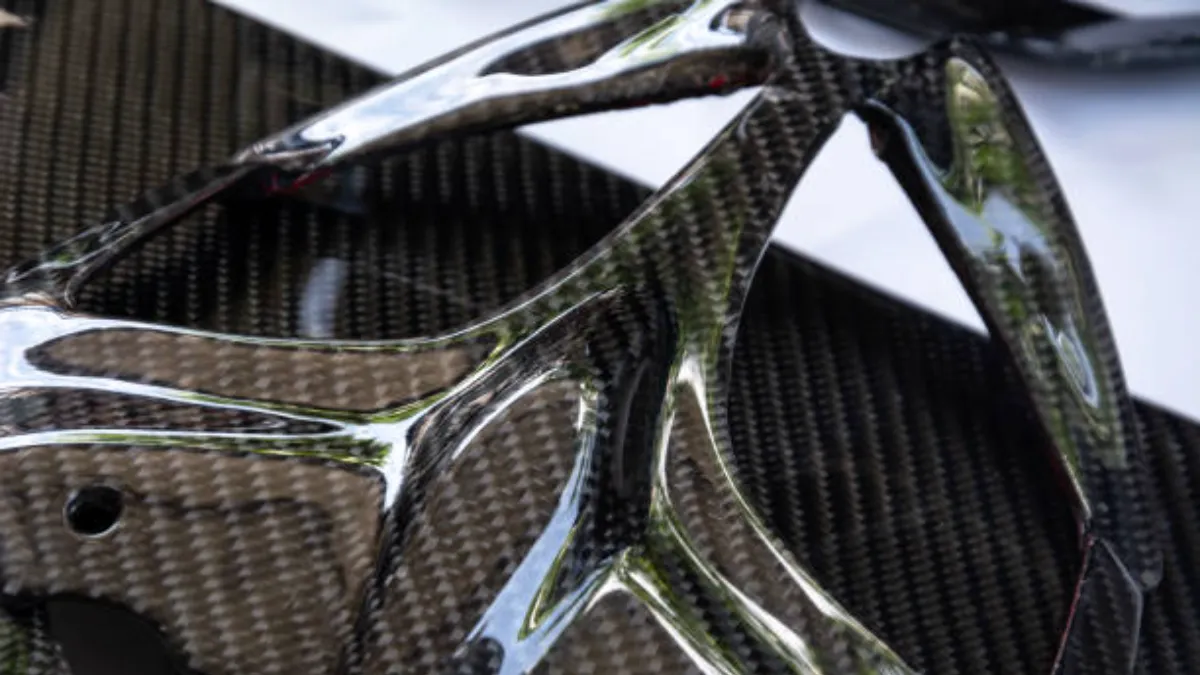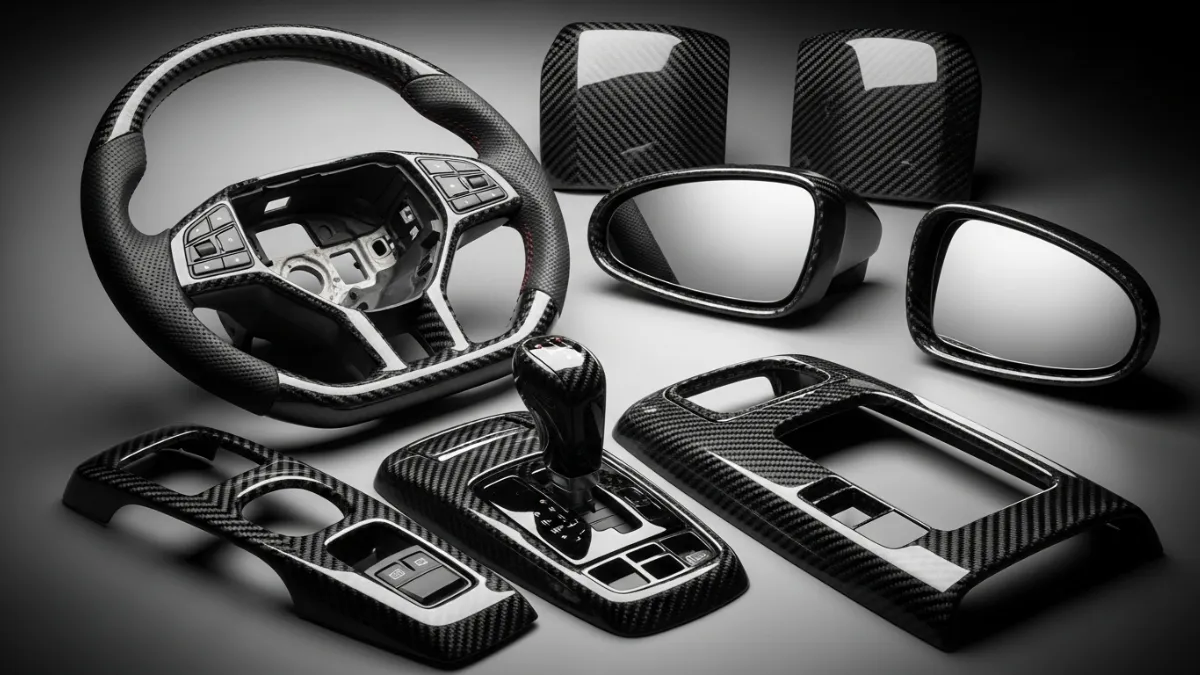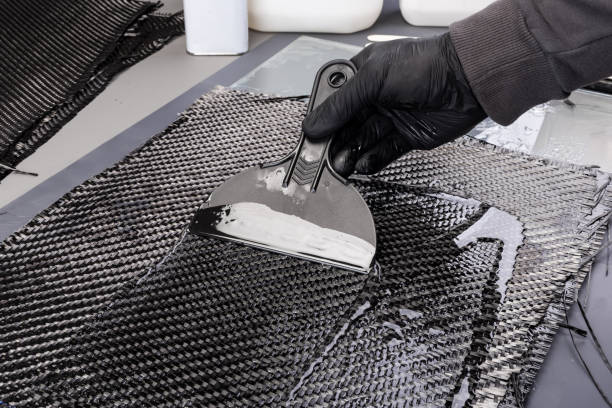
{"id":13960,"date":"2025-09-28T08:15:56","date_gmt":"2025-09-28T08:15:56","guid":{"rendered":"https:\/\/shashacarbon.com\/?p=13960"},"modified":"2025-09-29T01:19:40","modified_gmt":"2025-09-29T01:19:40","slug":"what-is-carbon-fiber-material","status":"publish","type":"post","link":"https:\/\/shashacarbon.com\/ar\/what-is-carbon-fiber-material\/","title":{"rendered":"What Is Carbon Fiber Material? A Complete Guide to Beginners"},"content":{"rendered":"<h2 class=\"wp-block-heading\"><strong>What Is Carbon Fiber Material?<\/strong><strong><\/strong><\/h2>\n\n\n\n<p>Carbon fiber is a material made of thin, strong crystalline filaments of carbon, essentially formed by carbon atoms bonded in long chains. Each filament is only about 5\u201310 microns in diameter, and thousands of these filaments are bundled into yarns or woven into fabrics. In this form, the material shows very high specific strength and specific modulus. It is stronger than steel in tensile strength while weighing only about one-fifth as much. Because of this outstanding strength-to-weight performance, carbon fiber is often called <a href=\"https:\/\/www.impact-fibers.com\/info\/why-is-carbon-fiber-called-black-gold-84553199.html\">&#8220;Black Gold&#8221;<\/a> and is widely used in aerospace, automotive, sports equipment, and medical devices.<\/p>\n\n\n\n<div style=\"height:100px\" aria-hidden=\"true\" class=\"wp-block-spacer\"><\/div>\n\n\n\n<h2 class=\"wp-block-heading\"><strong>What Does Carbon Fiber Look Like?<\/strong><strong><\/strong><\/h2>\n\n\n\n<figure class=\"wp-block-image size-large\"><img fetchpriority=\"high\" decoding=\"async\" width=\"1024\" height=\"576\" src=\"https:\/\/shashacarbon.com\/wp-content\/uploads\/2025\/09\/carbon-fiber-raw-material-1024x576.webp\" alt=\"carbon fiber raw material\" class=\"wp-image-13965\" srcset=\"https:\/\/shashacarbon.com\/wp-content\/uploads\/2025\/09\/carbon-fiber-raw-material-1024x576.webp 1024w, https:\/\/shashacarbon.com\/wp-content\/uploads\/2025\/09\/carbon-fiber-raw-material-300x169.webp 300w, https:\/\/shashacarbon.com\/wp-content\/uploads\/2025\/09\/carbon-fiber-raw-material-768x432.webp 768w, https:\/\/shashacarbon.com\/wp-content\/uploads\/2025\/09\/carbon-fiber-raw-material-18x10.webp 18w, https:\/\/shashacarbon.com\/wp-content\/uploads\/2025\/09\/carbon-fiber-raw-material-600x338.webp 600w, https:\/\/shashacarbon.com\/wp-content\/uploads\/2025\/09\/carbon-fiber-raw-material.webp 1200w\" sizes=\"(max-width: 1024px) 100vw, 1024px\" \/><\/figure>\n\n\n\n<p>Most people recognize carbon fiber by its unique \u201ccheckerboard\u201d pattern. This pattern comes from the way the fibers are woven into sheets. Depending on how the weave is designed, the surface can appear glossy, matte, or textured.<\/p>\n\n\n\n<p>Common patterns include:<\/p>\n\n\n\n<ul class=\"wp-block-list\">\n<li><strong>Plain weave<\/strong>: Simple over-under structure. It offers balanced strength in both directions and a uniform surface, making it popular for general use.<\/li>\n\n\n\n<li><strong>Twill weave<\/strong>: Diagonal lines that create a sleek, stylish look. It drapes more easily over curves, which is useful for complex car parts.<\/li>\n\n\n\n<li><strong>Unidirectional<\/strong>: Fibers aligned in one direction. This type maximizes strength along a single axis, ideal for parts requiring high stiffness.<\/li>\n<\/ul>\n\n\n\n<p>To learn more about their differences and benefits, check out our detailed guide: <a href=\"https:\/\/shashacarbon.com\/ar\/understand-the-different-weave-patterns-of-carbon-fiber-parts\/\"><em>Understand the Different Weave Patterns of Carbon Fiber Parts.<\/em><\/a><\/p>\n\n\n\n<div style=\"height:100px\" aria-hidden=\"true\" class=\"wp-block-spacer\"><\/div>\n\n\n\n<h2 class=\"wp-block-heading\"><strong>How Is Carbon Fiber Made?<\/strong><strong><\/strong><\/h2>\n\n\n\n<figure class=\"wp-block-image size-large\"><img decoding=\"async\" width=\"1024\" height=\"576\" src=\"https:\/\/shashacarbon.com\/wp-content\/uploads\/2025\/09\/carbon-fiber-car-parts-Prototype-1024x576.webp\" alt=\"carbon fiber car parts Prototype\" class=\"wp-image-13961\" srcset=\"https:\/\/shashacarbon.com\/wp-content\/uploads\/2025\/09\/carbon-fiber-car-parts-Prototype-1024x576.webp 1024w, https:\/\/shashacarbon.com\/wp-content\/uploads\/2025\/09\/carbon-fiber-car-parts-Prototype-300x169.webp 300w, https:\/\/shashacarbon.com\/wp-content\/uploads\/2025\/09\/carbon-fiber-car-parts-Prototype-768x432.webp 768w, https:\/\/shashacarbon.com\/wp-content\/uploads\/2025\/09\/carbon-fiber-car-parts-Prototype-18x10.webp 18w, https:\/\/shashacarbon.com\/wp-content\/uploads\/2025\/09\/carbon-fiber-car-parts-Prototype-600x338.webp 600w, https:\/\/shashacarbon.com\/wp-content\/uploads\/2025\/09\/carbon-fiber-car-parts-Prototype.webp 1200w\" sizes=\"(max-width: 1024px) 100vw, 1024px\" \/><\/figure>\n\n\n\n<p>The manufacturing process of carbon fiber is extremely complex. It begins with a raw material called precursor, often polyacrylonitrile (PAN). Around 90% of carbon fiber in the market today comes from PAN. Other precursors include pitch (a petroleum-based material known for producing very high modulus fibers) and rayon (less common now but used in early development).<\/p>\n\n\n\n<p>The main steps include:<\/p>\n\n\n\n<ol class=\"wp-block-list\">\n<li><strong>Spinning<\/strong>: The precursor is spun into long filaments.<\/li>\n\n\n\n<li><strong>Stabilization<\/strong>: The filaments are chemically treated at low heat to stabilize their structure.<\/li>\n\n\n\n<li><strong>Carbonization<\/strong>: The fibers are heated in high temperatures (1000\u20133000\u00b0C) in an oxygen-free environment. At this stage, non-carbon atoms are removed, leaving mostly carbon.<\/li>\n\n\n\n<li><strong>Surface treatment<\/strong>: The surface is treated so it can bond better with resins.<\/li>\n\n\n\n<li><strong>Sizing<\/strong>: A protective coating is applied to make handling easier.<\/li>\n<\/ol>\n\n\n\n<p>The result is a strong, flexible fiber that can be woven into cloth and combined with epoxy resin to make rigid carbon fiber composites.<\/p>\n\n\n\n<div style=\"height:100px\" aria-hidden=\"true\" class=\"wp-block-spacer\"><\/div>\n\n\n\n<h2 class=\"wp-block-heading\"><strong>Key Properties of Carbon Fiber<\/strong><strong><\/strong><\/h2>\n\n\n\n<p>Carbon fiber is admired because it combines properties that usually don\u2019t go together. Let\u2019s look at the main ones:<\/p>\n\n\n\n<ul class=\"wp-block-list\">\n<li><strong>High strength-to-weight ratio<\/strong>: Five times stronger than steel, but only one-fifth the weight.<\/li>\n\n\n\n<li><strong>\u0635\u0644\u0627\u0628\u0629<\/strong>: Excellent rigidity compared to metals, making it ideal for parts that need to resist bending.<\/li>\n\n\n\n<li><strong>Corrosion resistance<\/strong>: Unlike steel, it does not rust.<\/li>\n\n\n\n<li><strong>Thermal expansion<\/strong>: Very low, which means it does not expand or contract much with temperature changes.<\/li>\n\n\n\n<li><strong>Fatigue resistance<\/strong>: Performs well under repeated stress cycles, important in aircraft and sports equipment.<\/li>\n\n\n\n<li><strong>Electrical conductivity<\/strong>: Conducts electricity, though less than metals.<\/li>\n<\/ul>\n\n\n\n<div style=\"height:100px\" aria-hidden=\"true\" class=\"wp-block-spacer\"><\/div>\n\n\n\n<h2 class=\"wp-block-heading\"><strong>Different Types of Carbon Fiber and Their Characteristics<\/strong><strong><\/strong><\/h2>\n\n\n\n<figure class=\"wp-block-image size-large\"><img decoding=\"async\" width=\"1024\" height=\"576\" src=\"https:\/\/shashacarbon.com\/wp-content\/uploads\/2025\/09\/carbon-fiber-interior-1024x576.webp\" alt=\"carbon fiber interior\" class=\"wp-image-13962\" srcset=\"https:\/\/shashacarbon.com\/wp-content\/uploads\/2025\/09\/carbon-fiber-interior-1024x576.webp 1024w, https:\/\/shashacarbon.com\/wp-content\/uploads\/2025\/09\/carbon-fiber-interior-300x169.webp 300w, https:\/\/shashacarbon.com\/wp-content\/uploads\/2025\/09\/carbon-fiber-interior-768x432.webp 768w, https:\/\/shashacarbon.com\/wp-content\/uploads\/2025\/09\/carbon-fiber-interior-18x10.webp 18w, https:\/\/shashacarbon.com\/wp-content\/uploads\/2025\/09\/carbon-fiber-interior-600x338.webp 600w, https:\/\/shashacarbon.com\/wp-content\/uploads\/2025\/09\/carbon-fiber-interior.webp 1200w\" sizes=\"(max-width: 1024px) 100vw, 1024px\" \/><\/figure>\n\n\n\n<p>Carbon fiber can be classified into different types based on its precursor material and performance characteristics. Below, we break down the main categories and explain their key features.<\/p>\n\n\n\n<div style=\"height:30px\" aria-hidden=\"true\" class=\"wp-block-spacer\"><\/div>\n\n\n\n<h3 class=\"wp-block-heading\"><strong>By Precursor Material<\/strong><strong><\/strong><\/h3>\n\n\n\n<p><strong>PAN-Based Carbon Fiber<\/strong> is made from polyacrylonitrile, the most widely used precursor today. It provides a good balance of strength, stiffness, and cost. Its main advantage is versatility, while the slightly lower stiffness compared with pitch-based fibers can be a limitation for highly structural parts. It is commonly used in automotive components, sports equipment, and general aerospace applications.<\/p>\n\n\n\n<p><strong>Pitch-Based Carbon Fiber<\/strong> comes from petroleum pitch and is known for very high stiffness. Its strength is slightly lower than PAN fibers, and it tends to be more brittle, making it harder to handle. However, its high modulus makes it ideal for satellite structures and advanced aerospace components.<\/p>\n\n\n\n<p><strong>Rayon-Based Carbon Fiber<\/strong> is derived from regenerated cellulose. Once widely used, it has lower strength and stiffness, so today it is mostly found in niche or educational applications. Its main benefit historically was cost efficiency, but it has largely been replaced by PAN.<\/p>\n\n\n\n<div style=\"height:30px\" aria-hidden=\"true\" class=\"wp-block-spacer\"><\/div>\n\n\n\n<h3 class=\"wp-block-heading\"><strong>By Performance (Tensile Strength and Modulus of Elasticity)<\/strong><strong><\/strong><\/h3>\n\n\n\n<p>The modulus of elasticity, also called elastic modulus, measures a material\u2019s stiffness\u2014how much it resists bending or stretching under stress. A higher modulus means the material is stiffer, while a lower modulus indicates more flexibility. Carbon fiber can be classified based on this property along with tensile strength:<\/p>\n\n\n\n<p><strong>Standard Modulus (SM)<\/strong> fibers offer a balanced combination of strength and stiffness. They are versatile and widely used in automotive parts and sports equipment.<\/p>\n\n\n\n<p><strong>Intermediate Modulus (IM)<\/strong> fibers provide higher stiffness, suitable for aerospace structures where weight and rigidity are critical.<\/p>\n\n\n\n<p><strong>High and Ultra-High Modulus (HM\/UHM)<\/strong> fibers maximize stiffness for demanding industrial and aerospace applications. These fibers are more brittle and expensive, so their use is limited to components where performance justifies cost.<\/p>\n\n\n\n<p>Read more: <em><a href=\"https:\/\/shashacarbon.com\/ar\/types-of-carbon-fiber\/\">Exploring the Different Types of Carbon Fiber Materials<\/a><\/em><\/p>\n\n\n\n<div style=\"height:100px\" aria-hidden=\"true\" class=\"wp-block-spacer\"><\/div>\n\n\n\n<h2 class=\"wp-block-heading\"><strong>Carbon Fiber vs. Other Materials<\/strong><strong><\/strong><\/h2>\n\n\n\n<figure class=\"wp-block-image size-large\"><img loading=\"lazy\" decoding=\"async\" width=\"1024\" height=\"576\" src=\"https:\/\/shashacarbon.com\/wp-content\/uploads\/2025\/09\/carbon-fiber-mirror-covers-1024x576.webp\" alt=\"carbon fiber mirror covers\" class=\"wp-image-13964\" srcset=\"https:\/\/shashacarbon.com\/wp-content\/uploads\/2025\/09\/carbon-fiber-mirror-covers-1024x576.webp 1024w, https:\/\/shashacarbon.com\/wp-content\/uploads\/2025\/09\/carbon-fiber-mirror-covers-300x169.webp 300w, https:\/\/shashacarbon.com\/wp-content\/uploads\/2025\/09\/carbon-fiber-mirror-covers-768x432.webp 768w, https:\/\/shashacarbon.com\/wp-content\/uploads\/2025\/09\/carbon-fiber-mirror-covers-18x10.webp 18w, https:\/\/shashacarbon.com\/wp-content\/uploads\/2025\/09\/carbon-fiber-mirror-covers-600x338.webp 600w, https:\/\/shashacarbon.com\/wp-content\/uploads\/2025\/09\/carbon-fiber-mirror-covers.webp 1200w\" sizes=\"(max-width: 1024px) 100vw, 1024px\" \/><\/figure>\n\n\n\n<p>To understand carbon fiber better, let\u2019s compare it with common alternatives:<\/p>\n\n\n\n<h3 class=\"wp-block-heading\"><strong>Carbon Fiber vs. Steel<\/strong><strong><\/strong><\/h3>\n\n\n\n<p>Steel is an iron-carbon alloy valued for its toughness and impact resistance. Its metallic bonds allow it to deform under stress, giving it high toughness but lower stiffness. Steel is dense, around 7.8 g\/cm\u00b3, making it much heavier than carbon fiber. Its tensile strength per weight is lower because the metal\u2019s structure cannot match the aligned carbon chains of carbon fiber in specific strength and modulus.<\/p>\n\n\n\n<div style=\"height:30px\" aria-hidden=\"true\" class=\"wp-block-spacer\"><\/div>\n\n\n\n<h3 class=\"wp-block-heading\"><strong>Carbon Fiber vs. Aluminum<\/strong><strong><\/strong><\/h3>\n\n\n\n<p>Aluminum is a lightweight, corrosion-resistant metal commonly used in engineering. Its metallic bonds allow plastic deformation, so its tensile strength and stiffness are lower than carbon fiber. Aluminum\u2019s density is 2.7 g\/cm\u00b3, making it heavier relative to stiffness in performance-critical applications. Carbon fiber surpasses aluminum in strength-to-weight efficiency and rigidity due to the crystalline alignment of carbon filaments.<\/p>\n\n\n\n<div style=\"height:30px\" aria-hidden=\"true\" class=\"wp-block-spacer\"><\/div>\n\n\n\n<h3 class=\"wp-block-heading\"><strong>Carbon Fiber vs. Fiberglass<\/strong><strong><\/strong><\/h3>\n\n\n\n<p>Fiberglass is made of glass fibers within a resin matrix. Glass fibers are weaker and less stiff than carbon fibers, and the composite is heavier for the same structural performance. Its material flexibility allows deformation before breaking, but reduces load-bearing efficiency. Carbon fiber offers superior specific strength and modulus due to its crystalline structure.<\/p>\n\n\n\n<div style=\"height:30px\" aria-hidden=\"true\" class=\"wp-block-spacer\"><\/div>\n\n\n\n<h3 class=\"wp-block-heading\"><strong>Carbon Fiber vs. Titanium<\/strong><strong><\/strong><\/h3>\n\n\n\n<p>Titanium is a strong, corrosion-resistant metal used in aerospace and medical fields. Its metallic bonding provides toughness but limits elastic modulus compared with carbon fiber. Titanium\u2019s density of 4.5 g\/cm\u00b3 makes it heavier per unit stiffness. Carbon fiber achieves higher strength-to-weight and stiffness-to-weight ratios than titanium, thanks to its aligned carbon chains.<\/p>\n\n\n\n<div style=\"height:30px\" aria-hidden=\"true\" class=\"wp-block-spacer\"><\/div>\n\n\n\n<p><strong>See<\/strong><strong> Table Below: <\/strong><strong><\/strong><\/p>\n\n\n\n<figure class=\"wp-block-table\"><table class=\"has-fixed-layout\"><tbody><tr><td><strong>Material<\/strong><\/td><td><strong>Tensile Strength (MPa)<\/strong><\/td><td><strong>Modulus of Elasticity (GPa)<\/strong><\/td><td><strong>Density (g\/cm\u00b3)<\/strong><\/td><td><strong>Specific Modulus (GPa\u00b7cm\u00b3\/g)<\/strong><\/td><\/tr><tr><td><strong>Carbon Fiber<\/strong><\/td><td>3500\u20137000<\/td><td>70\u2013294<\/td><td>1.6<\/td><td>43.75\u2013183.75<\/td><\/tr><tr><td><strong>Steel<\/strong><\/td><td>400\u2013550<\/td><td>200<\/td><td>7.8<\/td><td>25.64\u201335.71<\/td><\/tr><tr><td><strong>Aluminum Alloy 6061-T6<\/strong><\/td><td>310<\/td><td>69<\/td><td>2.7<\/td><td>25.56<\/td><\/tr><tr><td><strong>Fiberglass (E-glass)<\/strong><\/td><td>1950\u20132050<\/td><td>72\u201385<\/td><td>2.5<\/td><td>28.80\u201334.00<\/td><\/tr><tr><td><strong>Titanium Alloy Ti-6Al-4V<\/strong><\/td><td>1000<\/td><td>120<\/td><td>4.42<\/td><td>27.17<\/td><\/tr><\/tbody><\/table><\/figure>\n\n\n\n<p><strong><em>Note:<\/em><\/strong><em> The specific modulus is a measure of a material&#8217;s stiffness-to-weight ratio, calculated as the modulus of elasticity divided by density. Higher values indicate better performance in weight-sensitive applications.<\/em><\/p>\n\n\n\n<div style=\"height:100px\" aria-hidden=\"true\" class=\"wp-block-spacer\"><\/div>\n\n\n\n<h2 class=\"wp-block-heading\"><strong>Most Common Applications of Carbon Fiber Across Industries<\/strong><strong><\/strong><\/h2>\n\n\n\n<figure class=\"wp-block-image size-large\"><img loading=\"lazy\" decoding=\"async\" width=\"1024\" height=\"576\" src=\"https:\/\/shashacarbon.com\/wp-content\/uploads\/2025\/09\/carbon-fiber-interiors-2-1024x576.webp\" alt=\"carbon fiber interiors 2\" class=\"wp-image-13963\" srcset=\"https:\/\/shashacarbon.com\/wp-content\/uploads\/2025\/09\/carbon-fiber-interiors-2-1024x576.webp 1024w, https:\/\/shashacarbon.com\/wp-content\/uploads\/2025\/09\/carbon-fiber-interiors-2-300x169.webp 300w, https:\/\/shashacarbon.com\/wp-content\/uploads\/2025\/09\/carbon-fiber-interiors-2-768x432.webp 768w, https:\/\/shashacarbon.com\/wp-content\/uploads\/2025\/09\/carbon-fiber-interiors-2-18x10.webp 18w, https:\/\/shashacarbon.com\/wp-content\/uploads\/2025\/09\/carbon-fiber-interiors-2-600x338.webp 600w, https:\/\/shashacarbon.com\/wp-content\/uploads\/2025\/09\/carbon-fiber-interiors-2.webp 1200w\" sizes=\"(max-width: 1024px) 100vw, 1024px\" \/><\/figure>\n\n\n\n<p>Carbon fiber is no longer a niche material. It appears in many fields today:<\/p>\n\n\n\n<ul class=\"wp-block-list\">\n<li><strong>Aerospace<\/strong>: Aircraft fuselages, wings, and interior structures. For example, the Boeing 787 Dreamliner uses about 50% composite materials, mainly carbon fiber.<\/li>\n\n\n\n<li><strong>Automotive<\/strong>: Sports cars, racing parts, and aftermarket car modifications. <a href=\"https:\/\/shashacarbon.com\/ar\/products_category\/carbon-fiber-exterior\/\">Carbon fiber exteriors<\/a> like hoods, spoilers, and mirror covers combine performance with aesthetics.<\/li>\n\n\n\n<li><strong>Sports equipment<\/strong>: Tennis rackets, bicycles, fishing rods, golf clubs. Athletes love the strength without added weight.<\/li>\n\n\n\n<li><strong>Medical field<\/strong>: Prosthetics, wheelchairs, imaging equipment frames. Its lightness improves patient comfort.<\/li>\n\n\n\n<li><strong>Industrial<\/strong>: Wind turbine blades, pressure vessels, and robotic arms.<\/li>\n<\/ul>\n\n\n\n<div style=\"height:100px\" aria-hidden=\"true\" class=\"wp-block-spacer\"><\/div>\n\n\n\n<h2 class=\"wp-block-heading\"><strong>Advantages and Limitations of Carbon Fiber<\/strong><strong><\/strong><\/h2>\n\n\n\n<p>Like any material, carbon fiber has pros and cons.<\/p>\n\n\n\n<p><strong>Advantages:<\/strong><\/p>\n\n\n\n<ul class=\"wp-block-list\">\n<li><strong>Lightweight yet strong:<\/strong> Carbon fiber offers extremely high tensile strength while remaining very light, making it ideal for applications where reducing weight is critical.<\/li>\n\n\n\n<li><strong>Good for complex shapes:<\/strong> Its flexibility in fabric form allows it to be molded into intricate geometries that are difficult to achieve with metals.<\/li>\n\n\n\n<li><strong>Aesthetic appeal:<\/strong> The woven patterns of carbon fiber give a premium, high-tech look, often used in automotive and consumer products.<\/li>\n\n\n\n<li><strong>Fatigue and corrosion resistance:<\/strong> Unlike metals, carbon fiber does not corrode and maintains performance under repeated stress cycles.<\/li>\n<\/ul>\n\n\n\n<p><strong>Limitations:<\/strong><\/p>\n\n\n\n<ul class=\"wp-block-list\">\n<li><strong>High cost:<\/strong> The expensive raw materials and the time-consuming and technically demanding production process make carbon fiber a costly material type.<\/li>\n\n\n\n<li><strong>Brittleness:<\/strong> Carbon fiber can crack or shatter under sharp impact because it lacks the ductility of metals.<\/li>\n\n\n\n<li><strong>Manufacturing complexity:<\/strong> Producing high-quality carbon fiber components requires precise layering, curing, and handling, making the process more complicated than traditional metal fabrication.<\/li>\n\n\n\n<li><strong>Repair difficulty:<\/strong> Damaged carbon fiber parts are hard to repair effectively; unlike metals, they cannot be easily reshaped or welded.<\/li>\n<\/ul>\n\n\n\n<div style=\"height:100px\" aria-hidden=\"true\" class=\"wp-block-spacer\"><\/div>\n\n\n\n<h2 class=\"wp-block-heading\"><strong>How Much Does Carbon Fiber Cost?<\/strong><strong><\/strong><\/h2>\n\n\n\n<figure class=\"wp-block-image size-large\"><img loading=\"lazy\" decoding=\"async\" width=\"1024\" height=\"576\" src=\"https:\/\/shashacarbon.com\/wp-content\/uploads\/2025\/09\/carbon-fiber-spoiler-1024x576.webp\" alt=\"carbon fiber spoiler\" class=\"wp-image-13966\" srcset=\"https:\/\/shashacarbon.com\/wp-content\/uploads\/2025\/09\/carbon-fiber-spoiler-1024x576.webp 1024w, https:\/\/shashacarbon.com\/wp-content\/uploads\/2025\/09\/carbon-fiber-spoiler-300x169.webp 300w, https:\/\/shashacarbon.com\/wp-content\/uploads\/2025\/09\/carbon-fiber-spoiler-768x432.webp 768w, https:\/\/shashacarbon.com\/wp-content\/uploads\/2025\/09\/carbon-fiber-spoiler-18x10.webp 18w, https:\/\/shashacarbon.com\/wp-content\/uploads\/2025\/09\/carbon-fiber-spoiler-600x338.webp 600w, https:\/\/shashacarbon.com\/wp-content\/uploads\/2025\/09\/carbon-fiber-spoiler.webp 1200w\" sizes=\"(max-width: 1024px) 100vw, 1024px\" \/><\/figure>\n\n\n\n<p>Carbon fiber is expensive, mainly due to energy costs and complex processing. Prices vary depending on grade and form:<\/p>\n\n\n\n<ul class=\"wp-block-list\">\n<li><strong>Raw fiber<\/strong>: $10\u2013$20 per pound for standard modulus, and up to $100 per pound for aerospace grades.<\/li>\n\n\n\n<li><strong>Finished sheets or parts<\/strong>: Can be $20\u2013$40 per square foot, depending on thickness and weave.<\/li>\n<\/ul>\n\n\n\n<p><em>The exact price depends on fiber grade, weave pattern, resin system, and production volume.<\/em><\/p>\n\n\n\n<div style=\"height:100px\" aria-hidden=\"true\" class=\"wp-block-spacer\"><\/div>\n\n\n\n<h2 class=\"wp-block-heading\"><strong>Sustainability and Recycling of Carbon Fiber Materials<\/strong><strong><\/strong><\/h2>\n\n\n\n<p>One challenge with carbon fiber is sustainability. Unlike metals, recycling is not easy. Traditional burning or shredding can damage fibers. However, new recycling methods are being developed, such as:<\/p>\n\n\n\n<ul class=\"wp-block-list\">\n<li><strong>Pyrolysis<\/strong>: Heating in absence of oxygen to recover fibers.<\/li>\n\n\n\n<li><strong>Solvolysis<\/strong>: Using solvents to break down resins without damaging fibers.<\/li>\n<\/ul>\n\n\n\n<p>Recycled carbon fiber can retain up to 90% of original strength, and it\u2019s already being used in non-structural car parts or consumer goods.<\/p>\n\n\n\n<p>The industry is also working on lowering energy use during production. For example, alternative precursors like lignin (from plants) are being tested to replace PAN, potentially reducing costs and emissions.<\/p>\n\n\n\n<div style=\"height:100px\" aria-hidden=\"true\" class=\"wp-block-spacer\"><\/div>\n\n\n\n<h2 class=\"wp-block-heading\"><strong>FAQs<\/strong><strong><\/strong><\/h2>\n\n\n\n<h3 class=\"wp-block-heading\"><strong>What exactly is carbon fiber made of?<\/strong><strong><\/strong><\/h3>\n\n\n\n<p>Carbon fiber is made from organic precursors, most commonly polyacrylonitrile (PAN). These precursors are heated and transformed into long chains of bonded carbon atoms, which are then bundled into fibers.<\/p>\n\n\n\n<div style=\"height:20px\" aria-hidden=\"true\" class=\"wp-block-spacer\"><\/div>\n\n\n\n<h3 class=\"wp-block-heading\"><strong>Is carbon fiber a plastic?<\/strong><strong><\/strong><\/h3>\n\n\n\n<p>Not exactly. Carbon fiber itself is not plastic; it is a reinforcement material made of carbon atoms. However, in most applications, it is combined with a plastic resin (such as epoxy) to form a composite known as carbon fiber reinforced polymer (CFRP).<\/p>\n\n\n\n<div style=\"height:20px\" aria-hidden=\"true\" class=\"wp-block-spacer\"><\/div>\n\n\n\n<h3 class=\"wp-block-heading\"><strong>Why is carbon fiber so expensive?<\/strong><strong><\/strong><\/h3>\n\n\n\n<p>Carbon fiber is costly because its production requires high energy, precise equipment, and long processing times. The precursor materials, like PAN, also add to the expense.<\/p>\n\n\n\n<div style=\"height:20px\" aria-hidden=\"true\" class=\"wp-block-spacer\"><\/div>\n\n\n\n<h3 class=\"wp-block-heading\"><strong>Can carbon fiber parts be repaired?<\/strong><strong><\/strong><\/h3>\n\n\n\n<p>Small surface damage can sometimes be patched, but serious cracks often compromise strength. In most cases, replacement is recommended for safety.<\/p>\n\n\n\n<div style=\"height:20px\" aria-hidden=\"true\" class=\"wp-block-spacer\"><\/div>\n\n\n\n<h3 class=\"wp-block-heading\"><strong>Is carbon fiber safe for daily use in cars?<\/strong><strong><\/strong><\/h3>\n\n\n\n<p>Yes. Carbon fiber composites are strong, lightweight, and widely used in automotive and aerospace industries. If you\u2019re looking for a reliable <a href=\"https:\/\/shashacarbon.com\/ar\">\u0645\u064f\u0635\u0646\u0650\u0651\u0639 \u0642\u0637\u0639 \u063a\u064a\u0627\u0631 \u0627\u0644\u0633\u064a\u0627\u0631\u0627\u062a \u0627\u0644\u0645\u0635\u0646\u0648\u0639\u0629 \u0645\u0646 \u0623\u0644\u064a\u0627\u0641 \u0627\u0644\u0643\u0631\u0628\u0648\u0646<\/a>, we specialize in producing high-quality interior and exterior components tailored for performance and durability.<\/p>\n\n\n\n<div style=\"height:20px\" aria-hidden=\"true\" class=\"wp-block-spacer\"><\/div>\n\n\n\n<h3 class=\"wp-block-heading\"><strong>Will carbon fiber become cheaper in the future?<\/strong><strong><\/strong><\/h3>\n\n\n\n<p>Likely. Prices may decrease as recycling methods improve and alternative precursors are developed. However, it will likely remain more expensive than steel or aluminum.<\/p>\n\n\n\n<p><\/p>","protected":false},"excerpt":{"rendered":"<p>What is carbon fiber material? Strong, lightweight, and durable, it\u2019s transforming industries from cars to aerospace. Have a project? Contact us today!<\/p>","protected":false},"author":2,"featured_media":13967,"comment_status":"open","ping_status":"open","sticky":false,"template":"","format":"standard","meta":{"_acf_changed":false,"footnotes":""},"categories":[39],"tags":[],"class_list":["post-13960","post","type-post","status-publish","format-standard","has-post-thumbnail","hentry","category-all"],"acf":[],"yoast_head":"<!-- This site is optimized with the Yoast SEO plugin v20.4 - https:\/\/yoast.com\/wordpress\/plugins\/seo\/ -->\n<title>What Is Carbon Fiber Material? | Shasha Carbon Fiber<\/title>\n<meta name=\"description\" content=\"What is carbon fiber material? Strong, lightweight, and durable, it\u2019s transforming industries from cars to aerospace. Have a project? Contact us today!\" \/>\n<meta name=\"robots\" content=\"index, follow, max-snippet:-1, max-image-preview:large, max-video-preview:-1\" \/>\n<link rel=\"canonical\" href=\"https:\/\/shashacarbon.com\/ar\/what-is-carbon-fiber-material\/\" \/>\n<meta property=\"og:locale\" content=\"ar_AR\" \/>\n<meta property=\"og:type\" content=\"article\" \/>\n<meta property=\"og:title\" content=\"What Is Carbon Fiber Material? | Shasha Carbon Fiber\" \/>\n<meta property=\"og:description\" content=\"What is carbon fiber material? Strong, lightweight, and durable, it\u2019s transforming industries from cars to aerospace. Have a project? Contact us today!\" \/>\n<meta property=\"og:url\" content=\"https:\/\/shashacarbon.com\/ar\/what-is-carbon-fiber-material\/\" \/>\n<meta property=\"og:site_name\" content=\"ShaShaCarbon\" \/>\n<meta property=\"article:published_time\" content=\"2025-09-28T08:15:56+00:00\" \/>\n<meta property=\"article:modified_time\" content=\"2025-09-29T01:19:40+00:00\" \/>\n<meta property=\"og:image\" content=\"https:\/\/shashacarbon.com\/wp-content\/uploads\/2025\/09\/what-is-carbon-fiber-material-cover.webp\" \/>\n\t<meta property=\"og:image:width\" content=\"1200\" \/>\n\t<meta property=\"og:image:height\" content=\"675\" \/>\n\t<meta property=\"og:image:type\" content=\"image\/webp\" \/>\n<meta name=\"author\" content=\"infilityfun@gmail.com\" \/>\n<meta name=\"twitter:card\" content=\"summary_large_image\" \/>\n<meta name=\"twitter:label1\" content=\"\u0643\u064f\u062a\u0628 \u0628\u0648\u0627\u0633\u0637\u0629\" \/>\n\t<meta name=\"twitter:data1\" content=\"infilityfun@gmail.com\" \/>\n\t<meta name=\"twitter:label2\" content=\"\u0648\u0642\u062a \u0627\u0644\u0642\u0631\u0627\u0621\u0629 \u0627\u0644\u0645\u064f\u0642\u062f\u0651\u0631\" \/>\n\t<meta name=\"twitter:data2\" content=\"10 \u062f\u0642\u0627\u0626\u0642\" \/>\n<script type=\"application\/ld+json\" class=\"yoast-schema-graph\">{\"@context\":\"https:\/\/schema.org\",\"@graph\":[{\"@type\":\"WebPage\",\"@id\":\"https:\/\/shashacarbon.com\/what-is-carbon-fiber-material\/\",\"url\":\"https:\/\/shashacarbon.com\/what-is-carbon-fiber-material\/\",\"name\":\"What Is Carbon Fiber Material? | Shasha Carbon Fiber\",\"isPartOf\":{\"@id\":\"https:\/\/shashacarbon.com\/#website\"},\"datePublished\":\"2025-09-28T08:15:56+00:00\",\"dateModified\":\"2025-09-29T01:19:40+00:00\",\"author\":{\"@id\":\"https:\/\/shashacarbon.com\/#\/schema\/person\/522303af42a65c3bae48118b1869df4f\"},\"description\":\"What is carbon fiber material? Strong, lightweight, and durable, it\u2019s transforming industries from cars to aerospace. Have a project? Contact us today!\",\"breadcrumb\":{\"@id\":\"https:\/\/shashacarbon.com\/what-is-carbon-fiber-material\/#breadcrumb\"},\"inLanguage\":\"ar\",\"potentialAction\":[{\"@type\":\"ReadAction\",\"target\":[\"https:\/\/shashacarbon.com\/what-is-carbon-fiber-material\/\"]}]},{\"@type\":\"BreadcrumbList\",\"@id\":\"https:\/\/shashacarbon.com\/what-is-carbon-fiber-material\/#breadcrumb\",\"itemListElement\":[{\"@type\":\"ListItem\",\"position\":1,\"name\":\"Home\",\"item\":\"https:\/\/shashacarbon.com\/\"},{\"@type\":\"ListItem\",\"position\":2,\"name\":\"What Is Carbon Fiber Material? A Complete Guide to Beginners\"}]},{\"@type\":\"WebSite\",\"@id\":\"https:\/\/shashacarbon.com\/#website\",\"url\":\"https:\/\/shashacarbon.com\/\",\"name\":\"ShaShaCarbon\",\"description\":\"\",\"potentialAction\":[{\"@type\":\"SearchAction\",\"target\":{\"@type\":\"EntryPoint\",\"urlTemplate\":\"https:\/\/shashacarbon.com\/?s={search_term_string}\"},\"query-input\":\"required name=search_term_string\"}],\"inLanguage\":\"ar\"},{\"@type\":\"Person\",\"@id\":\"https:\/\/shashacarbon.com\/#\/schema\/person\/522303af42a65c3bae48118b1869df4f\",\"name\":\"infilityfun@gmail.com\",\"image\":{\"@type\":\"ImageObject\",\"inLanguage\":\"ar\",\"@id\":\"https:\/\/shashacarbon.com\/#\/schema\/person\/image\/\",\"url\":\"https:\/\/secure.gravatar.com\/avatar\/b817fe97f54b75c2e2e43d98888f8835a808e72961453f5dc482acab62334aa2?s=96&d=mm&r=g\",\"contentUrl\":\"https:\/\/secure.gravatar.com\/avatar\/b817fe97f54b75c2e2e43d98888f8835a808e72961453f5dc482acab62334aa2?s=96&d=mm&r=g\",\"caption\":\"infilityfun@gmail.com\"},\"url\":\"https:\/\/shashacarbon.com\/ar\/author\/infilityfungmail-com\/\"}]}<\/script>\n<!-- \/ Yoast SEO plugin. -->","yoast_head_json":{"title":"What Is Carbon Fiber Material? | Shasha Carbon Fiber","description":"What is carbon fiber material? Strong, lightweight, and durable, it\u2019s transforming industries from cars to aerospace. Have a project? Contact us today!","robots":{"index":"index","follow":"follow","max-snippet":"max-snippet:-1","max-image-preview":"max-image-preview:large","max-video-preview":"max-video-preview:-1"},"canonical":"https:\/\/shashacarbon.com\/ar\/what-is-carbon-fiber-material\/","og_locale":"ar_AR","og_type":"article","og_title":"What Is Carbon Fiber Material? | Shasha Carbon Fiber","og_description":"What is carbon fiber material? Strong, lightweight, and durable, it\u2019s transforming industries from cars to aerospace. Have a project? Contact us today!","og_url":"https:\/\/shashacarbon.com\/ar\/what-is-carbon-fiber-material\/","og_site_name":"ShaShaCarbon","article_published_time":"2025-09-28T08:15:56+00:00","article_modified_time":"2025-09-29T01:19:40+00:00","og_image":[{"width":1200,"height":675,"url":"https:\/\/shashacarbon.com\/wp-content\/uploads\/2025\/09\/what-is-carbon-fiber-material-cover.webp","type":"image\/webp"}],"author":"infilityfun@gmail.com","twitter_card":"summary_large_image","twitter_misc":{"\u0643\u064f\u062a\u0628 \u0628\u0648\u0627\u0633\u0637\u0629":"infilityfun@gmail.com","\u0648\u0642\u062a \u0627\u0644\u0642\u0631\u0627\u0621\u0629 \u0627\u0644\u0645\u064f\u0642\u062f\u0651\u0631":"10 \u062f\u0642\u0627\u0626\u0642"},"schema":{"@context":"https:\/\/schema.org","@graph":[{"@type":"WebPage","@id":"https:\/\/shashacarbon.com\/what-is-carbon-fiber-material\/","url":"https:\/\/shashacarbon.com\/what-is-carbon-fiber-material\/","name":"What Is Carbon Fiber Material? | Shasha Carbon Fiber","isPartOf":{"@id":"https:\/\/shashacarbon.com\/#website"},"datePublished":"2025-09-28T08:15:56+00:00","dateModified":"2025-09-29T01:19:40+00:00","author":{"@id":"https:\/\/shashacarbon.com\/#\/schema\/person\/522303af42a65c3bae48118b1869df4f"},"description":"What is carbon fiber material? Strong, lightweight, and durable, it\u2019s transforming industries from cars to aerospace. Have a project? Contact us today!","breadcrumb":{"@id":"https:\/\/shashacarbon.com\/what-is-carbon-fiber-material\/#breadcrumb"},"inLanguage":"ar","potentialAction":[{"@type":"ReadAction","target":["https:\/\/shashacarbon.com\/what-is-carbon-fiber-material\/"]}]},{"@type":"BreadcrumbList","@id":"https:\/\/shashacarbon.com\/what-is-carbon-fiber-material\/#breadcrumb","itemListElement":[{"@type":"ListItem","position":1,"name":"Home","item":"https:\/\/shashacarbon.com\/"},{"@type":"ListItem","position":2,"name":"What Is Carbon Fiber Material? A Complete Guide to Beginners"}]},{"@type":"WebSite","@id":"https:\/\/shashacarbon.com\/#website","url":"https:\/\/shashacarbon.com\/","name":"ShaShaCarbon","description":"","potentialAction":[{"@type":"SearchAction","target":{"@type":"EntryPoint","urlTemplate":"https:\/\/shashacarbon.com\/?s={search_term_string}"},"query-input":"required name=search_term_string"}],"inLanguage":"ar"},{"@type":"Person","@id":"https:\/\/shashacarbon.com\/#\/schema\/person\/522303af42a65c3bae48118b1869df4f","name":"infilityfun@gmail.com","image":{"@type":"ImageObject","inLanguage":"ar","@id":"https:\/\/shashacarbon.com\/#\/schema\/person\/image\/","url":"https:\/\/secure.gravatar.com\/avatar\/b817fe97f54b75c2e2e43d98888f8835a808e72961453f5dc482acab62334aa2?s=96&d=mm&r=g","contentUrl":"https:\/\/secure.gravatar.com\/avatar\/b817fe97f54b75c2e2e43d98888f8835a808e72961453f5dc482acab62334aa2?s=96&d=mm&r=g","caption":"infilityfun@gmail.com"},"url":"https:\/\/shashacarbon.com\/ar\/author\/infilityfungmail-com\/"}]}},"_links":{"self":[{"href":"https:\/\/shashacarbon.com\/ar\/wp-json\/wp\/v2\/posts\/13960","targetHints":{"allow":["GET"]}}],"collection":[{"href":"https:\/\/shashacarbon.com\/ar\/wp-json\/wp\/v2\/posts"}],"about":[{"href":"https:\/\/shashacarbon.com\/ar\/wp-json\/wp\/v2\/types\/post"}],"author":[{"embeddable":true,"href":"https:\/\/shashacarbon.com\/ar\/wp-json\/wp\/v2\/users\/2"}],"replies":[{"embeddable":true,"href":"https:\/\/shashacarbon.com\/ar\/wp-json\/wp\/v2\/comments?post=13960"}],"version-history":[{"count":0,"href":"https:\/\/shashacarbon.com\/ar\/wp-json\/wp\/v2\/posts\/13960\/revisions"}],"wp:featuredmedia":[{"embeddable":true,"href":"https:\/\/shashacarbon.com\/ar\/wp-json\/wp\/v2\/media\/13967"}],"wp:attachment":[{"href":"https:\/\/shashacarbon.com\/ar\/wp-json\/wp\/v2\/media?parent=13960"}],"wp:term":[{"taxonomy":"category","embeddable":true,"href":"https:\/\/shashacarbon.com\/ar\/wp-json\/wp\/v2\/categories?post=13960"},{"taxonomy":"post_tag","embeddable":true,"href":"https:\/\/shashacarbon.com\/ar\/wp-json\/wp\/v2\/tags?post=13960"}],"curies":[{"name":"wp","href":"https:\/\/api.w.org\/{rel}","templated":true}]}}