
Choosing the right custom carbon fiber manufacturer is essential for product quality, دقة الأبعاد, production consistency, and long-term business success. Whether you are an automotive parts distributor, an e-commerce brand, a product designer, or an industrial manufacturer, understanding a factory’s capabilities can help you avoid costly mistakes and build a reliable supply chain.
Carbon fiber is widely used in automotive components, طائرات بدون طيار, sporting goods, industrial equipment, consumer products, and many other applications. لكن, not every manufacturer has the same production capabilities. Material selection, mold development, عمليات التصنيع, surface finishing, and quality control all influence the final product.
في هذا الدليل, we explain what to look for when selecting a custom carbon fiber manufacturer, how the OEM/ODM development process works, and what information you should prepare before requesting a quotation.
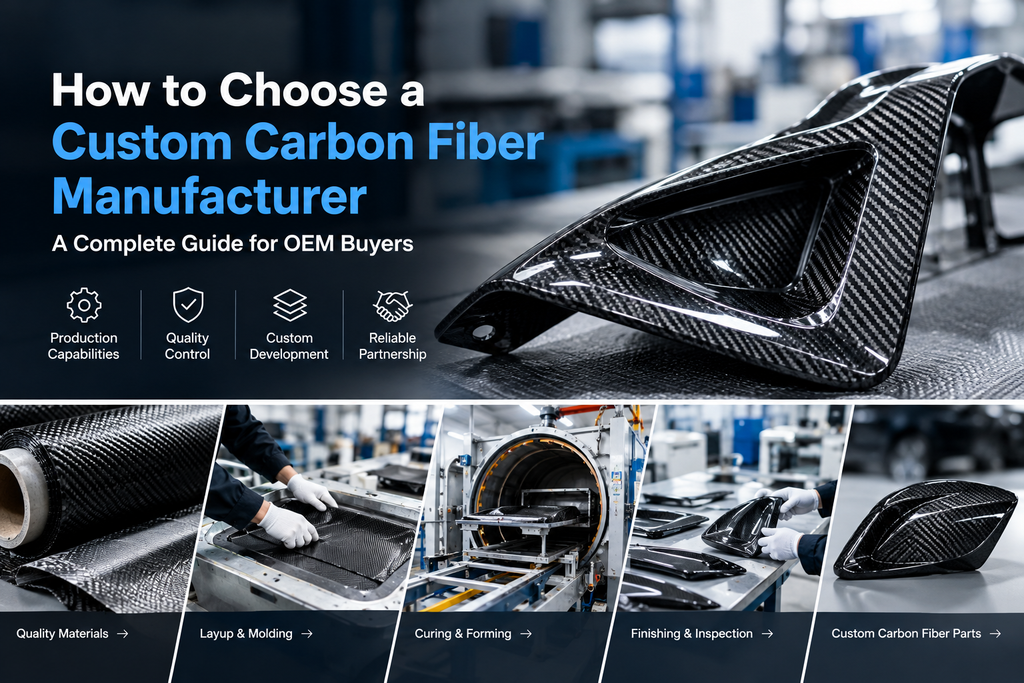
1. What Does a Custom Carbon Fiber Manufacturer Do?
A custom carbon fiber manufacturer develops and produces carbon fiber components according to a customer’s drawings, physical samples, 3D models, or technical specifications.
Unlike standard off-the-shelf products, custom carbon fiber parts may require dedicated tooling, specialized material preparation, controlled forming processes, and precise finishing.
Depending on the project, a manufacturer may support:
- OEM manufacturing: Producing components according to the customer’s existing design and specifications.
- ODM development: Supporting product development based on the customer’s concept, reference sample, or functional requirements.
- Mold and tooling development: Creating molds for components with specific shapes and dimensions.
- Surface customization: Offering different weave patterns, finishes, colors, and other appearance options.
- Batch production: Manufacturing repeat orders with consistent specifications and agreed quality standards.
For B2B buyers, choosing a manufacturer with suitable in-house capabilities can simplify communication between product development, الأدوات, production, and quality inspection.
2. Check the Manufacturer’s Production Capabilities
Before requesting a quotation, confirm whether the factory can manufacture your specific product.
Carbon fiber parts vary significantly in geometry, سماكة, مظهر, structural requirements, and production volume. A supplier experienced in flat carbon fiber sheets may not necessarily be suitable for complex molded components.
Here are five important areas to evaluate.
اختيار المواد
Carbon fiber fabric, prepreg, resin systems, and other composite materials serve different purposes. The appropriate material depends on the product’s intended application, الخواص الميكانيكية المطلوبة, مظهر, operating environment, and budget.
على سبيل المثال, visible automotive trim may prioritize a consistent weave pattern and high-quality surface finish, while a structural component may require more detailed consideration of load direction, الكزازة, and laminate design.
تطوير العفن
Complex, curved, or irregular parts often require dedicated tooling. Mold design affects the final geometry, جودة السطح, دقة الأبعاد, and repeatability of production.
Before starting a project, clarify the mold cost, development schedule, tooling ownership, and whether the mold can support your expected production volume.
عملية التصنيع
Different manufacturing processes suit different products. Prepreg layup and controlled curing are commonly used for high-quality composite components, while other molding methods may be more appropriate for different geometries or production volumes.
The correct process should be selected according to the actual product requirements rather than price alone.
التشطيب السطح
For visible carbon fiber products, surface quality is a major consideration.
Important details include weave alignment, resin distribution, gloss or matte finish, edge quality, coating consistency, and the presence of visible surface defects.
If appearance is critical to your brand, request a physical sample and agree on an acceptable finish before mass production.
مراقبة الجودة
A professional manufacturing process should include clearly defined inspection procedures.
Depending on the product, these may cover dimensional checks, الفحص العيني, mounting-hole positions, surface finish, material specifications, and other project-specific requirements.
For repeat orders, approved samples and controlled drawing revisions help maintain consistency between production batches.
3. What Is the Custom Carbon Fiber Manufacturing Process?
A typical OEM/ODM project follows several stages, from initial inquiry to mass production.
خطوة 1: Submit a Drawing, 3D File, or Physical Sample
The first step is to provide the information needed to understand your product.
You can submit a 2D engineering drawing, a 3D CAD file, a physical sample, or clear reference photographs with dimensions.
For automotive components, include the vehicle model, سنة الموديل, trim version, and any relevant left-hand-drive or right-hand-drive requirements.
For non-automotive products, describe the intended application and any important structural or installation requirements.
خطوة 2: Review Product Feasibility
The manufacturer evaluates the product geometry, material requirements, عملية التصنيع, tooling needs, and expected production volume.
This stage helps identify potential design issues before tooling begins.
For complex components, additional engineering discussion may be necessary to confirm dimensions, mounting interfaces, wall thickness, and other critical details.
خطوة 3: Confirm the Quotation
A complete quotation should clarify the relevant commercial terms, مشتمل:
- Tooling or mold development costs, where applicable.
- Sample or prototype costs.
- Unit pricing at different order quantities.
- Minimum order quantity, if applicable.
- Estimated development and production lead times.
- Packaging requirements and shipping terms.
Separating tooling costs from unit prices makes it easier to evaluate the total investment and compare suppliers fairly.
خطوة 4: Develop the Mold and Produce Samples
Once the project specifications and commercial terms are approved, the manufacturer proceeds with tooling and sample development.
The first sample allows the customer to evaluate product dimensions, مظهر, assembly interfaces, and other important requirements.
For parts that must fit existing equipment or vehicle components, physical fitment testing is particularly important.
خطوة 5: Approve the Sample Before Mass Production
Before approving bulk production, confirm that the sample meets the agreed specifications.
Any necessary changes should be documented and reflected in the approved drawing or sample reference.
This step reduces the risk of producing an entire batch with an incorrect dimension, ينهي, or interface.
خطوة 6: Mass Production and Quality Inspection
After sample approval, production can proceed according to the agreed manufacturing and inspection requirements.
For repeat orders, maintaining consistent material specifications, process parameters, finishing standards, and drawing revisions is essential.
The goal is not simply to produce a satisfactory first sample, but to establish a repeatable process for future orders.
4. How to Evaluate Carbon Fiber Quality
Carbon fiber quality is not determined by appearance alone.
A glossy surface and attractive weave may be important for decorative components, but they do not independently prove a product’s structural performance or manufacturing consistency.
When evaluating a potential supplier, consider the following factors.
Weave consistency: Visible fiber patterns should meet the agreed appearance requirements, particularly on exposed surfaces.
Surface finish: Check for bubbles, pinholes, scratches, uneven coating, and other defects relevant to the product specification.
Dimensional accuracy: Critical dimensions, mounting holes, edges, and interfaces should match the approved drawing or sample within the agreed tolerances.
Fitment and assembly: Components designed to fit an existing product should be checked against the relevant mating parts.
Batch consistency: Repeat orders should follow the same approved material, مظهر, and dimensional standards unless a change is agreed upon.
Application-specific performance: Structural parts may require additional testing or documentation based on their operating environment and intended use.
For B2B purchasing, the best approach is to define measurable acceptance criteria before production rather than relying on general descriptions such as “high quality.”
5. What Affects the Cost of Custom Carbon Fiber Parts?
The cost of a custom carbon fiber product depends on several factors. Understanding them helps buyers plan development budgets and compare quotations.
Tooling and Mold Complexity
Products with complex curves, undercuts, tight tolerances, or specialized mounting features may require more sophisticated tooling.
A mold is often a separate initial investment, particularly when developing a new product from a drawing or sample.
Material and Manufacturing Process
Material grade, fiber construction, resin system, laminate design, curing requirements, and finishing methods can all influence the final cost.
A decorative component and a load-bearing structural component may require different material and process specifications, even when their external shapes appear similar.
Product Size and Geometry
Large components may consume more material and require larger molds or processing equipment. Small but highly complex parts can also be expensive because of labor-intensive layup, detailed finishing, or tight dimensional requirements.
Order Quantity
The total tooling investment can often be distributed across more units when production volume increases.
لكن, the actual savings depend on the mold design, عملية التصنيع, القدرة الإنتاجية, and order schedule.
For new products, a practical strategy is to evaluate the initial tooling investment separately from the unit cost and then compare different production-volume scenarios.
6. Which Industries Can Benefit from Custom Carbon Fiber Manufacturing?
Custom carbon fiber manufacturing is not limited to automotive products. It can support a broad range of B2B applications.
Automotive Components
Applications include interior trim panels, center console covers, door trim, تقليم عجلة القيادة, exterior decorative components, and other vehicle-specific parts.
الإعداد, مظهر, mounting interfaces, and compatibility with the intended vehicle version are important considerations.
Drones and UAVs
Carbon fiber may be used for housings, frames, arms, يغطي, and other components where weight, الكزازة, and geometry are important.
Material selection should reflect the actual structural requirements and operating conditions.
Sporting Goods
Potential applications include selected bicycle components, equipment housings, protective shells, and other customized composite parts.
Product design, impact requirements, متانة, and applicable safety standards should be evaluated for each project.
Industrial Equipment
Carbon fiber components can be developed for equipment covers, lightweight panels, housings, fixtures, and specialized structures.
The appropriate material and process depend on the required stiffness, environmental resistance, operating conditions, and expected service life.
Consumer Product Housings
Brands may use custom carbon fiber shells or enclosures for selected premium products, including electronic device housings, equipment covers, and specialized product casings.
In shell-only projects, the customer should clearly define which components are supplied by the carbon fiber manufacturer and which components, such as electronics, batteries, motors, or other accessories, must be supplied separately.
The key principle is to select a manufacturer based on the actual product requirements, not simply on whether the supplier advertises carbon fiber products.
7. Five Questions to Ask Before Choosing a Supplier
Before placing an order, ask your potential manufacturer these questions.
1. Can you manufacture according to my drawing or physical sample?
Confirm whether the supplier can develop the required geometry and whether reverse engineering or additional design work is necessary.
2. Do you support mold development and sample production?
Understand which development stages are handled in-house and which may require external partners.
3. How do you control product dimensions and surface quality?
Ask about inspection procedures, sample approval, production records, and how deviations are handled.
4. What are your MOQ, tooling costs, and production lead times?
Request a quotation based on your intended quantity and clarify whether development, sampling, and production schedules are estimated separately.
5. Can you support repeat orders and long-term OEM cooperation?
للموزعين, brand owners, and manufacturers, reliable repeat production is often more important than a low initial quotation.
A clear agreement on specifications, quality standards, packaging, and order changes can help establish a more stable supplier relationship.
8. How to Request a Faster and More Accurate Quotation
The more complete your initial project information is, the easier it is for a manufacturer to assess feasibility and prepare a meaningful quotation.
Before contacting a supplier, prepare the following:
- Product information: اسم, intended application, and reference photographs.
- Design files: 2D drawings, 3D CAD files, or a physical sample, if available.
- Dimensions: Overall measurements and critical tolerances.
- Material and appearance: Preferred carbon fiber pattern, ينهي, اللون, and any known performance requirements.
- Order quantity: Prototype quantity, initial order quantity, and estimated future demand.
- Commercial requirements: Target delivery date, packaging, labeling, and any relevant testing or documentation.
- Development requirements: Whether you need a new mold, reverse engineering, sample development, or production from an existing design.
You do not need to have every engineering detail finalized before making an inquiry. If you have a physical sample or an initial concept, a preliminary discussion can help identify the information needed to move forward.
9. Why Work with Shasha Carbon for Custom Carbon Fiber Parts?
Shasha Carbon focuses on the development and manufacturing of carbon fiber components, including dry carbon fiber automotive interior trim and other customized parts.
For business customers, our manufacturing approach centers on understanding product requirements, evaluating manufacturing feasibility, and coordinating development with the customer’s specifications.
Our capabilities include mold and tooling development, carbon fiber layup, controlled forming and curing, surface finishing, and quality inspection.
We support projects based on customer-provided samples, رسومات, and other available product information, subject to technical feasibility and project requirements.
Whether you are an automotive parts distributor, an e-commerce brand, a product developer, or another manufacturer looking for a carbon fiber production partner, the first step is to clarify your product design, target quantity, and quality expectations.
Our goal is to help business customers turn product concepts and existing designs into manufacturable carbon fiber components for repeatable production.
الأسئلة المتداولة
Can a manufacturer develop custom carbon fiber parts from a physical sample?
نعم. A physical sample can serve as a reference for dimensions, shape, mounting interfaces, والمظهر. Depending on the part, additional measurement, 3D scanning, engineering work, or design confirmation may be required before tooling begins.
Do I need a 3D drawing to start a custom carbon fiber project?
ليس بالضرورة. A 3D CAD file can improve communication and speed up technical evaluation, but a physical sample, 2D drawing, or clear reference information may also be sufficient to begin a preliminary assessment.
Is there a minimum order quantity for custom carbon fiber parts?
MOQ depends on the product, tooling requirements, عملية التصنيع, and production economics. Some projects may begin with sample development or a small pilot batch, while others are more suitable for larger production runs. Confirm the requirements with the manufacturer before placing an order.
How long does custom carbon fiber development take?
The timeline depends on design complexity, mold development, material availability, sample revisions, and production scheduling. A realistic schedule should separate engineering review, الأدوات, sampling, sample approval, and mass production.
Can I customize the carbon fiber weave and surface finish?
Many products can be developed with different weave patterns and surface finishes, depending on the material system, mold geometry, and manufacturing process. Confirm the available options with your manufacturer and approve a representative sample before mass production.
What is the difference between OEM and ODM carbon fiber manufacturing?
OEM manufacturing generally follows a customer’s established design and specifications. ODM involves a greater level of product development or design support from the manufacturer. Actual responsibilities vary by project, so both parties should agree on design ownership, tooling ownership, confidentiality, and technical responsibilities in writing.
الأفكار النهائية
Choosing the right custom carbon fiber manufacturer requires more than comparing unit prices. Material selection, tooling capability, manufacturing process control, surface finishing, دقة الأبعاد, and communication all contribute to a successful project.
For B2B buyers, the most effective approach is to define product requirements early, evaluate the manufacturer’s relevant experience, approve a representative sample, and establish clear quality standards before mass production.
If your company is developing a new carbon fiber product or looking for an OEM manufacturing partner, preparing your drawings, reference samples, and target order quantity is a practical first step.
Looking for a custom carbon fiber manufacturing partner? Contact Shasha Carbon to discuss your project. Send us your product drawings, 3D files, or physical sample information, along with your target quantity and customization requirements, so our team can evaluate the next steps.
Shasha Carbon — Custom Carbon Fiber Manufacturing for B2B Projects.


