



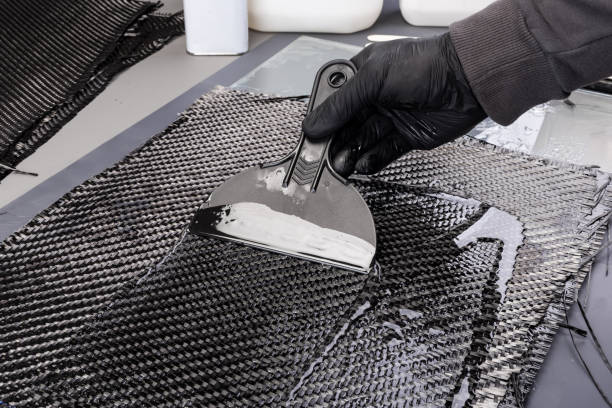

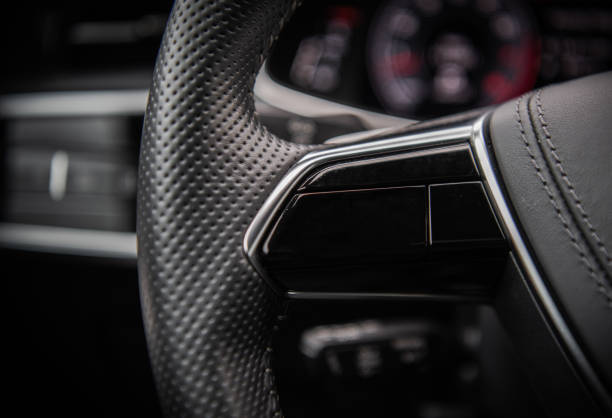

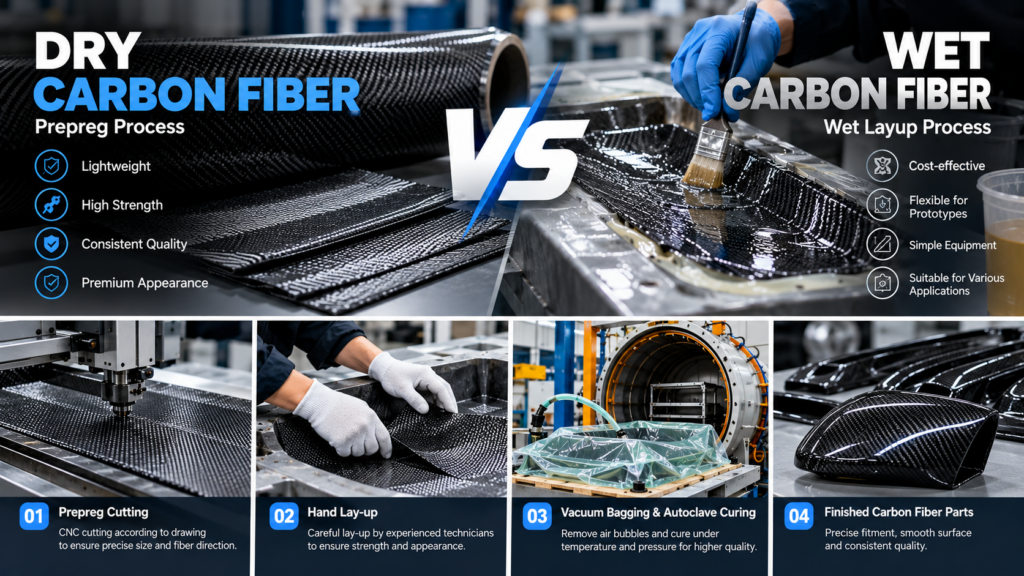
{"id":14140,"date":"2026-06-01T07:53:23","date_gmt":"2026-06-01T07:53:23","guid":{"rendered":"https:\/\/shashacarbon.com\/?p=14140"},"modified":"2026-06-01T07:53:26","modified_gmt":"2026-06-01T07:53:26","slug":"how-to-make-carbon-fiber-car-parts-guide","status":"publish","type":"post","link":"https:\/\/shashacarbon.com\/es\/how-to-make-carbon-fiber-car-parts-guide\/","title":{"rendered":"How to Make Carbon Fiber Car Parts: Step-by-Step Guide"},"content":{"rendered":"<p class=\"wp-block-paragraph\">Producing high-quality carbon fiber car parts is not simply a matter of laying fabric into a mold. Problems such as poor fitment, surface defects, inconsistent weave patterns, and hidden structural weaknesses can increase production costs, create customer complaints, and reduce confidence in the final product.<\/p>\n\n\n\n<p class=\"wp-block-paragraph\">The difference between a professional-grade component and an average one often comes down to process control. Understanding how molds, materials, layup methods, curing systems, and finishing techniques work together makes it easier to evaluate manufacturing quality, avoid costly mistakes, and achieve more reliable results for automotive projects and commercial production.<\/p>\n\n\n\n<h2 class=\"wp-block-heading\">What Type of Carbon Fiber Parts Do You Want to Make?<\/h2>\n\n\n\n<figure class=\"wp-block-image size-full is-resized\"><img fetchpriority=\"high\" decoding=\"async\" width=\"429\" height=\"286\" src=\"https:\/\/shashacarbon.com\/wp-content\/uploads\/2026\/06\/a-close-up-of-the-interior-of-a-car-carbon-fiber.webp\" alt=\"a close up of the interior of a car carbon fiber\" class=\"wp-image-14935\" style=\"object-fit:cover;width:1200px;height:675px\" srcset=\"https:\/\/shashacarbon.com\/wp-content\/uploads\/2026\/06\/a-close-up-of-the-interior-of-a-car-carbon-fiber.webp 429w, https:\/\/shashacarbon.com\/wp-content\/uploads\/2026\/06\/a-close-up-of-the-interior-of-a-car-carbon-fiber-300x200.webp 300w, https:\/\/shashacarbon.com\/wp-content\/uploads\/2026\/06\/a-close-up-of-the-interior-of-a-car-carbon-fiber-18x12.webp 18w\" sizes=\"(max-width: 429px) 100vw, 429px\" \/><\/figure>\n\n\n\n<p class=\"wp-block-paragraph\"><a href=\"https:\/\/shashacarbon.com\/es\/types-of-carbon-fiber\/\">Different carbon fiber<\/a> automotive parts require different engineering approaches based on their function. The category you choose directly determines material selection, mold precision, curing process, and final finishing quality. Choosing the wrong type early can lead to cost waste and performance issues in production.<\/p>\n\n\n\n<h3 class=\"wp-block-heading\"><strong>Decorative vs Structural Automotive Parts<\/strong><strong><\/strong><\/h3>\n\n\n\n<p class=\"wp-block-paragraph\">Carbon fiber components fall into two main categories: decorative and structural.<\/p>\n\n\n\n<p class=\"wp-block-paragraph\">The table below highlights the key differences between them.<\/p>\n\n\n\n<table style=\"width:100%; border-collapse:collapse; font-family:Arial, sans-serif; font-size:14px; color:#111;\">\n  <thead>\n    <tr style=\"background-color:#111; color:#fff;\">\n      <th style=\"padding:12px; border:1px solid #ddd;\">Aspect<\/th>\n      <th style=\"padding:12px; border:1px solid #ddd;\">Decorative<\/th>\n      <th style=\"padding:12px; border:1px solid #ddd;\">Structural<\/th>\n    <\/tr>\n  <\/thead>\n  <tbody>\n    <tr>\n      <td style=\"padding:12px; border:1px solid #ddd;\"><b>Purpose<\/b><\/td>\n      <td style=\"padding:12px; border:1px solid #ddd;\">Visual appearance<\/td>\n      <td style=\"padding:12px; border:1px solid #ddd;\">Load-bearing function<\/td>\n    <\/tr>\n    <tr style=\"background-color:#f7f7f7;\">\n      <td style=\"padding:12px; border:1px solid #ddd;\"><b>Surface<\/b><\/td>\n      <td style=\"padding:12px; border:1px solid #ddd;\">Smooth weave finish<\/td>\n      <td style=\"padding:12px; border:1px solid #ddd;\">Functional durability<\/td>\n    <\/tr>\n    <tr>\n      <td style=\"padding:12px; border:1px solid #ddd;\"><b>Material<\/b><\/td>\n      <td style=\"padding:12px; border:1px solid #ddd;\">Appearance-focused composites<\/td>\n      <td style=\"padding:12px; border:1px solid #ddd;\">High-strength laminates<\/td>\n    <\/tr>\n    <tr style=\"background-color:#f7f7f7;\">\n      <td style=\"padding:12px; border:1px solid #ddd;\"><b>Tolerance<\/b><\/td>\n      <td style=\"padding:12px; border:1px solid #ddd;\">Moderate control<\/td>\n      <td style=\"padding:12px; border:1px solid #ddd;\">Strict precision required<\/td>\n    <\/tr>\n  <\/tbody>\n<\/table>\n\n\n\n<p class=\"wp-block-paragraph\">As structural requirements increase, production becomes more sensitive to defects and process control.<\/p>\n\n\n\n<h3 class=\"wp-block-heading\"><strong>Interior Trim vs Exterior Components<\/strong><strong><\/strong><\/h3>\n\n\n\n<p class=\"wp-block-paragraph\">Another classification is based on the working environment.<\/p>\n\n\n\n<p class=\"wp-block-paragraph\"><a href=\"https:\/\/shashacarbon.com\/es\/products_category\/carbon-fiber-interior\/\">Interior parts<\/a> operate in stable cabin conditions. The focus is fitment accuracy, surface finish, and visual consistency such as weave alignment and gloss level.<\/p>\n\n\n\n<p class=\"wp-block-paragraph\"><a href=\"https:\/\/shashacarbon.com\/es\/products_category\/carbon-fiber-exterior\/\">Exterior parts<\/a> face harsher environments such as UV, moisture, temperature changes, vibration, and road impact. This requires stronger laminates and more durable coatings.<\/p>\n\n\n\n<table style=\"width:100%; border-collapse:collapse; font-family:Arial, sans-serif; font-size:14px; color:#111;\">\n  <thead>\n    <tr style=\"background-color:#111; color:#fff;\">\n      <th style=\"padding:12px; border:1px solid #ddd;\">Type<\/th>\n      <th style=\"padding:12px; border:1px solid #ddd;\">Environment<\/th>\n      <th style=\"padding:12px; border:1px solid #ddd;\">Focus<\/th>\n      <th style=\"padding:12px; border:1px solid #ddd;\">Requirement<\/th>\n    <\/tr>\n  <\/thead>\n  <tbody>\n    <tr>\n      <td style=\"padding:12px; border:1px solid #ddd;\">Interior Trim<\/td>\n      <td style=\"padding:12px; border:1px solid #ddd;\">Stable cabin<\/td>\n      <td style=\"padding:12px; border:1px solid #ddd;\">Visual quality<\/td>\n      <td style=\"padding:12px; border:1px solid #ddd;\">Fitment &#038; finish<\/td>\n    <\/tr>\n    <tr style=\"background-color:#f7f7f7;\">\n      <td style=\"padding:12px; border:1px solid #ddd;\">Exterior Parts<\/td>\n      <td style=\"padding:12px; border:1px solid #ddd;\">Harsh exposure<\/td>\n      <td style=\"padding:12px; border:1px solid #ddd;\">Durabilidad<\/td>\n      <td style=\"padding:12px; border:1px solid #ddd;\">Structural protection<\/td>\n    <\/tr>\n  <\/tbody>\n<\/table>\n\n\n\n<p class=\"wp-block-paragraph\"><br>This classification directly affects material selection, curing strategy, and finishing process.<\/p>\n\n\n\n<h2 class=\"wp-block-heading\"><strong>Choosing the Right Mold and Materials<\/strong><strong><\/strong><\/h2>\n\n\n\n<figure class=\"wp-block-image size-full is-resized\"><img decoding=\"async\" width=\"512\" height=\"288\" src=\"https:\/\/shashacarbon.com\/wp-content\/uploads\/2026\/05\/Black-carbon-fiber-composite-raw-material-with-hand.webp\" alt=\"Black carbon fiber composite raw material with hand\" class=\"wp-image-14889\" style=\"object-fit:cover;width:1200px;height:675px\" srcset=\"https:\/\/shashacarbon.com\/wp-content\/uploads\/2026\/05\/Black-carbon-fiber-composite-raw-material-with-hand.webp 512w, https:\/\/shashacarbon.com\/wp-content\/uploads\/2026\/05\/Black-carbon-fiber-composite-raw-material-with-hand-300x169.webp 300w, https:\/\/shashacarbon.com\/wp-content\/uploads\/2026\/05\/Black-carbon-fiber-composite-raw-material-with-hand-18x10.webp 18w\" sizes=\"(max-width: 512px) 100vw, 512px\" \/><\/figure>\n\n\n\n<p class=\"wp-block-paragraph\">Project complexity plays an important role in carbon fiber manufacturing, especially for beginners.<\/p>\n\n\n\n<p class=\"wp-block-paragraph\">Different part sizes require different levels of process control and material handling.<\/p>\n\n\n\n<h3 class=\"wp-block-heading\"><strong>Mold Options for Different Production Volumes<\/strong><strong><\/strong><\/h3>\n\n\n\n<p class=\"wp-block-paragraph\">The mold determines the final shape, surface quality, and dimensional accuracy of every carbon fiber part. Different production volumes require different tooling solutions.<\/p>\n\n\n\n<p class=\"wp-block-paragraph\"><strong>3D-printed molds<\/strong> are suitable for prototypes and single parts, offering fast turnaround and low cost for early-stage validation.<\/p>\n\n\n\n<p class=\"wp-block-paragraph\"><strong>Fiberglass molds<\/strong> are commonly used for small to medium production runs, balancing durability and cost efficiency.<\/p>\n\n\n\n<p class=\"wp-block-paragraph\"><strong>CNC-machined molds <\/strong>are used for OEM production, providing the highest precision and repeatability for large-scale manufacturing.<\/p>\n\n\n\n<h3 class=\"wp-block-heading\"><strong>Carbon Fiber Fabrics, Resins and Core Materials<\/strong><strong><\/strong><\/h3>\n\n\n\n<p class=\"wp-block-paragraph\">A carbon fiber part depends on the interaction of reinforcement, resin, and core materials rather than fabric alone.<\/p>\n\n\n\n<p class=\"wp-block-paragraph\">Carbon fiber fabric provides <a href=\"https:\/\/shashacarbon.com\/es\/what-is-the-tensile-strength-of-carbon-fiber-car-parts\/\">structural strength<\/a>, with twill weave used for appearance and unidirectional fabric used for directional performance.<\/p>\n\n\n\n<p class=\"wp-block-paragraph\">Epoxy resin bonds the structure and transfers load, offering strong adhesion and long-term stability.<\/p>\n\n\n\n<p class=\"wp-block-paragraph\">Foam or honeycomb cores are used in sandwich structures to improve stiffness while reducing weight. how we ensure every part made with our Autoclave technology meets our &#8220;1:1 Fitment Guarantee.&#8221;<\/p>\n\n\n\n<h3 class=\"wp-block-heading\"><strong>Prepreg vs Wet Layup Materials<\/strong><strong><\/strong><\/h3>\n\n\n\n<p class=\"wp-block-paragraph\">Material choice depends on the production method, which directly affects quality and consistency.<\/p>\n\n\n\n<table style=\"width:100%; border-collapse:collapse; font-family:Arial, sans-serif; font-size:14px; color:#111;\">\n  <thead>\n    <tr style=\"background-color:#111; color:#fff;\">\n      <th style=\"padding:12px; border:1px solid #ddd;\">Aspect<\/th>\n      <th style=\"padding:12px; border:1px solid #ddd;\">Wet Layup<\/th>\n      <th style=\"padding:12px; border:1px solid #ddd;\">Prepreg System<\/th>\n    <\/tr>\n  <\/thead>\n\n  <tbody>\n    <tr>\n      <td style=\"padding:12px; border:1px solid #ddd;\">Material Setup<\/td>\n      <td style=\"padding:12px; border:1px solid #ddd;\">Manual resin application<\/td>\n      <td style=\"padding:12px; border:1px solid #ddd;\">Pre-impregnated fiber with controlled resin<\/td>\n    <\/tr>\n\n    <tr style=\"background-color:#f7f7f7;\">\n      <td style=\"padding:12px; border:1px solid #ddd;\">Costo<\/td>\n      <td style=\"padding:12px; border:1px solid #ddd;\">Lower initial investment<\/td>\n      <td style=\"padding:12px; border:1px solid #ddd;\">Higher material cost<\/td>\n    <\/tr>\n\n    <tr>\n      <td style=\"padding:12px; border:1px solid #ddd;\">Consistency<\/td>\n      <td style=\"padding:12px; border:1px solid #ddd;\">Depends on operator skill<\/td>\n      <td style=\"padding:12px; border:1px solid #ddd;\">Highly consistent quality<\/td>\n    <\/tr>\n\n    <tr style=\"background-color:#f7f7f7;\">\n      <td style=\"padding:12px; border:1px solid #ddd;\">Best Use<\/td>\n      <td style=\"padding:12px; border:1px solid #ddd;\">Prototype and small batch production<\/td>\n      <td style=\"padding:12px; border:1px solid #ddd;\">OEM and high-performance parts<\/td>\n    <\/tr>\n  <\/tbody>\n<\/table>\n\n\n\n<p class=\"wp-block-paragraph\">Prepreg systems are preferred in automotive manufacturing due to higher repeatability and quality control. Wet layup is still widely used for prototyping and low-volume production.<\/p>\n\n\n\n<div style=\"background: #2D2D2D; border-radius: 10px; padding: 40px; margin: 40px 0; display: flex; flex-wrap: wrap; align-items: center; justify-content: space-between; gap: 30px; box-shadow: 0 4px 20px rgba(0,0,0,0.1);\">\n<div style=\"flex: 1 1 350px; min-width: 300px;\">\n<h2 class=\"cta-title\" style=\"margin-top: 0; color: #FFFFFF !important; font-size: 28px; line-height: 1.3; font-weight: 700; border: none; padding: 0;\">      Flawless Fitment, Premium Dry Carbon Accessories    <\/h2>\n<div style=\"font-size: 16px; color: #FFFFFF !important; line-height: 1.7; margin: 20px 0 30px 0;\">      Our CNC-machined dry carbon parts guarantee 1:1 OEM fitment, eliminating costly returns and customer complaints. Access over 2,000 SKUs with low MOQs and fast shipping to scale your premium auto accessories business.    <\/div>\n<p>        <a style=\"display: inline-block; background: #FFFFFF; color: #2D2D2D; padding: 14px 28px; font-family: sans-serif; font-weight: 700; font-size: 16px; border-radius: 6px; text-decoration: none; transition: all 0.3s ease;\" href=\"https:\/\/shashacarbon.com\/es\/contact-us\/\" target=\"_blank\" rel=\"noopener\">      Get a Wholesale Quote \u2192    <\/a>  <\/p><\/div>\n<div style=\"flex: 0 1 320px; min-width: 280px; text-align: center;\">    <img decoding=\"async\" style=\"width: 100%; height: auto; border-radius: 8px; object-fit: cover;\" src=\" https:\/\/shashacarbon.com\/wp-content\/uploads\/2026\/01\/P06-S03.jpg\" alt=\"CTA Image\">  <\/div>\n<\/div>\n\n\n\n<h2 class=\"wp-block-heading\"><strong>Step-by-Step Layup Process for Carbon Fiber Parts<\/strong><strong><\/strong><\/h2>\n\n\n\n<figure class=\"wp-block-image size-full is-resized\"><img decoding=\"async\" width=\"429\" height=\"286\" src=\"https:\/\/shashacarbon.com\/wp-content\/uploads\/2026\/06\/Close-up-of-carbon-fibre-gear.webp\" alt=\"Close up of carbon fibre gear\" class=\"wp-image-14928\" style=\"object-fit:cover;width:1200px;height:675px\" srcset=\"https:\/\/shashacarbon.com\/wp-content\/uploads\/2026\/06\/Close-up-of-carbon-fibre-gear.webp 429w, https:\/\/shashacarbon.com\/wp-content\/uploads\/2026\/06\/Close-up-of-carbon-fibre-gear-300x200.webp 300w, https:\/\/shashacarbon.com\/wp-content\/uploads\/2026\/06\/Close-up-of-carbon-fibre-gear-18x12.webp 18w\" sizes=\"(max-width: 429px) 100vw, 429px\" \/><\/figure>\n\n\n\n<p class=\"wp-block-paragraph\">Once the mold and materials are ready, the process moves into the layup stage. This is where carbon fiber layers are placed into the mold to form the final structure. The quality of this step directly affects strength, appearance, and dimensional stability.<\/p>\n\n\n\n<p class=\"wp-block-paragraph\">Small mistakes during layup can lead to defects such as weak spots, surface issues, or poor fitment later in production.<\/p>\n\n\n\n<p class=\"wp-block-paragraph\">You may be interested in: <a href=\"https:\/\/shashacarbon.com\/es\/carbon-fiber-layup-process-explained-for-automotive-parts\/\">Carbon Fiber Layup Process Explained for Automotive Parts<\/a><\/p>\n\n\n\n<h3 class=\"wp-block-heading\"><strong>Preparing the Mold Surface<\/strong><strong><\/strong><\/h3>\n\n\n\n<p class=\"wp-block-paragraph\">Layup starts with proper mold preparation. Dust, oil, or residue on the surface can transfer to the final part and affect both appearance and release performance.<\/p>\n\n\n\n<p class=\"wp-block-paragraph\">Before production, the mold must be cleaned and inspected. A release agent is applied to ensure the cured part can be removed safely without damage.<\/p>\n\n\n\n<p class=\"wp-block-paragraph\">For high-gloss automotive parts, mold condition is critical, as even small scratches may appear on the final surface.<\/p>\n\n\n\n<p class=\"wp-block-paragraph\">Proper preparation ensures three key results:<\/p>\n\n\n\n<ul class=\"wp-block-list\">\n<li><strong>Clean Release<\/strong>: Smooth demolding without damage<\/li>\n\n\n\n<li><strong>Surface Quality<\/strong>: Stable gloss and weave clarity<\/li>\n\n\n\n<li><strong>Process Consistency<\/strong>: Reliable results across production batches<\/li>\n<\/ul>\n\n\n\n<h3 class=\"wp-block-heading\"><strong>Placing Carbon Fiber and Applying Resin<\/strong><strong><\/strong><\/h3>\n\n\n\n<p class=\"wp-block-paragraph\">After preparation, carbon fiber layers are placed according to the required structure.<\/p>\n\n\n\n<p class=\"wp-block-paragraph\">Weave alignment must be carefully controlled for visible automotive parts, as even small shifts can reduce visual quality.<\/p>\n\n\n\n<p class=\"wp-block-paragraph\">Resin application depends on the process used. Wet layup relies on manual resin application to fully saturate each layer, while prepreg materials already contain controlled resin for higher consistency.<\/p>\n\n\n\n<p class=\"wp-block-paragraph\">Regardless of the method, each layer must lie flat. Wrinkles, air gaps, or uneven placement can create weak points and visible defects in the final part.<\/p>\n\n\n\n<h3 class=\"wp-block-heading\"><strong>Removing Air and Preparing for Curing<\/strong><strong><\/strong><\/h3>\n\n\n\n<p class=\"wp-block-paragraph\">Before curing, trapped air must be removed from the laminate. Air pockets can create internal voids that reduce strength and may also appear as surface defects.<\/p>\n\n\n\n<p class=\"wp-block-paragraph\">Technicians use rollers and consolidation tools to compact each layer and remove trapped air during layup. Additional layers are added according to the laminate schedule.<\/p>\n\n\n\n<p class=\"wp-block-paragraph\">At this stage, the focus shifts to consolidation. The goal is to create a uniform structure with stable fiber distribution across the entire component.<\/p>\n\n\n\n<p class=\"wp-block-paragraph\">Once completed, the part is ready for vacuum bagging and curing. Proper consolidation improves structural integrity and helps achieve a smoother final surface.er-to-resin ratio. This delivers the maximum possible strength with the absolute minimum weight in the finished part.<\/p>\n\n\n\n<h2 class=\"wp-block-heading\"><strong>Vacuum Bagging, Curing and Dry Carbon Production<\/strong><strong><\/strong><\/h2>\n\n\n<div class=\"wp-block-image\">\n<figure class=\"aligncenter size-full is-resized\"><img loading=\"lazy\" decoding=\"async\" width=\"768\" height=\"512\" src=\"https:\/\/shashacarbon.com\/wp-content\/uploads\/2026\/05\/Kevlar-carbon-fiber-texture-on-a-car.webp\" alt=\"Kevlar carbon fiber texture on a car\" class=\"wp-image-14848\" style=\"object-fit:cover;width:1200px;height:675px\" srcset=\"https:\/\/shashacarbon.com\/wp-content\/uploads\/2026\/05\/Kevlar-carbon-fiber-texture-on-a-car.webp 768w, https:\/\/shashacarbon.com\/wp-content\/uploads\/2026\/05\/Kevlar-carbon-fiber-texture-on-a-car-300x200.webp 300w, https:\/\/shashacarbon.com\/wp-content\/uploads\/2026\/05\/Kevlar-carbon-fiber-texture-on-a-car-18x12.webp 18w, https:\/\/shashacarbon.com\/wp-content\/uploads\/2026\/05\/Kevlar-carbon-fiber-texture-on-a-car-600x400.webp 600w\" sizes=\"(max-width: 768px) 100vw, 768px\" \/><\/figure>\n<\/div>\n\n\n<p class=\"wp-block-paragraph\">The curing stage turns a flexible laminate into a rigid composite. It directly determines strength, weight, and surface quality.<\/p>\n\n\n\n<p class=\"wp-block-paragraph\">Basic DIY methods often use room-temperature curing. In contrast, professional automotive production relies on controlled pressure and temperature systems for better stability and repeatability.<\/p>\n\n\n\n<h3 class=\"wp-block-heading\"><strong>Why Vacuum Bagging Improves Part Quality<\/strong><strong><\/strong><\/h3>\n\n\n\n<p class=\"wp-block-paragraph\">Vacuum bagging applies uniform pressure across the laminate to improve consolidation. It removes trapped air and excess resin while compressing all layers into a denser structure.<\/p>\n\n\n\n<p class=\"wp-block-paragraph\">This leads to a more stable laminate with improved mechanical performance and surface quality.<\/p>\n\n\n\n<p class=\"wp-block-paragraph\">Key benefits include lower void content, stronger fiber bonding, and more consistent load transfer. It also improves surface smoothness after curing.<\/p>\n\n\n\n<p class=\"wp-block-paragraph\">For automotive applications, vacuum bagging is generally considered a standard requirement for reliable structural and visual quality.<\/p>\n\n\n\n<h3 class=\"wp-block-heading\"><strong>DIY Curing vs Professional Autoclave Curing<\/strong><strong><\/strong><\/h3>\n\n\n\n<p class=\"wp-block-paragraph\">Curing methods differ mainly in how heat and pressure are controlled.<\/p>\n\n\n\n<p class=\"wp-block-paragraph\">Autoclave curing uses a sealed environment with controlled temperature and high pressure. This produces laminates with very low void content, stable structure, and high repeatability, making it suitable for automotive-grade production.<\/p>\n\n\n\n<h3 class=\"wp-block-heading\"><strong>Wet Carbon vs Dry Carbon Explained<\/strong><strong><\/strong><\/h3>\n\n\n\n<p class=\"wp-block-paragraph\">The main <a href=\"https:\/\/shashacarbon.com\/es\/dry-carbon-fiber-vs-wet-carbon-fiber\/\">difference between wet carbon and dry carbon<\/a> lies in resin control during manufacturing.<\/p>\n\n\n\n<table style=\"width:100%; border-collapse:collapse; font-family:Arial, sans-serif; font-size:14px; color:#111;\">\n  <thead>\n    <tr style=\"background-color:#111; color:#fff;\">\n      <th style=\"padding:12px; border:1px solid #ddd;\">Aspect<\/th>\n      <th style=\"padding:12px; border:1px solid #ddd;\">Wet Carbon<\/th>\n      <th style=\"padding:12px; border:1px solid #ddd;\">Dry Carbon<\/th>\n    <\/tr>\n  <\/thead>\n\n  <tbody>\n    <tr>\n      <td style=\"padding:12px; border:1px solid #ddd;\">Method<\/td>\n      <td style=\"padding:12px; border:1px solid #ddd;\">Manual resin application<\/td>\n      <td style=\"padding:12px; border:1px solid #ddd;\">Prepreg with controlled resin<\/td>\n    <\/tr>\n\n    <tr style=\"background-color:#f7f7f7;\">\n      <td style=\"padding:12px; border:1px solid #ddd;\">Peso<\/td>\n      <td style=\"padding:12px; border:1px solid #ddd;\">Higher resin content increases weight<\/td>\n      <td style=\"padding:12px; border:1px solid #ddd;\">Optimized fiber-to-resin ratio reduces weight<\/td>\n    <\/tr>\n\n    <tr>\n      <td style=\"padding:12px; border:1px solid #ddd;\">Consistency<\/td>\n      <td style=\"padding:12px; border:1px solid #ddd;\">Operator dependent<\/td>\n      <td style=\"padding:12px; border:1px solid #ddd;\">High repeatability<\/td>\n    <\/tr>\n\n    <tr style=\"background-color:#f7f7f7;\">\n      <td style=\"padding:12px; border:1px solid #ddd;\">Resultado<\/td>\n      <td style=\"padding:12px; border:1px solid #ddd;\">Heavier functional parts<\/td>\n      <td style=\"padding:12px; border:1px solid #ddd;\">Lightweight premium finish<\/td>\n    <\/tr>\n  <\/tbody>\n<\/table>\n\n\n\n<p class=\"wp-block-paragraph\"><br>Dry carbon is preferred in high-end automotive applications because it provides better control over weight, structure, and surface consistency.<\/p>\n\n\n\n<h2 class=\"wp-block-heading\"><strong>Trimming, Surface Preparation and Automotive Finishing<\/strong><strong><\/strong><\/h2>\n\n\n<div class=\"wp-block-image\">\n<figure class=\"aligncenter size-full is-resized\"><img loading=\"lazy\" decoding=\"async\" width=\"429\" height=\"286\" src=\"https:\/\/shashacarbon.com\/wp-content\/uploads\/2026\/06\/carbon-fiber-car-part-mirror.webp\" alt=\"carbon fiber car part mirror\" class=\"wp-image-14934\" style=\"object-fit:cover;width:1200px;height:675px\" srcset=\"https:\/\/shashacarbon.com\/wp-content\/uploads\/2026\/06\/carbon-fiber-car-part-mirror.webp 429w, https:\/\/shashacarbon.com\/wp-content\/uploads\/2026\/06\/carbon-fiber-car-part-mirror-300x200.webp 300w, https:\/\/shashacarbon.com\/wp-content\/uploads\/2026\/06\/carbon-fiber-car-part-mirror-18x12.webp 18w\" sizes=\"(max-width: 429px) 100vw, 429px\" \/><\/figure>\n<\/div>\n\n\n<p class=\"wp-block-paragraph\">A carbon fiber component does not reach final quality straight after molding. Post-processing defines fitment accuracy, surface finish, and long-term durability. Poor trimming or finishing can reduce the perceived quality even of a well-cured part.<\/p>\n\n\n\n<h3 class=\"wp-block-heading\"><strong>Trimming and Edge Finishing<\/strong><strong><\/strong><\/h3>\n\n\n\n<p class=\"wp-block-paragraph\">After curing, excess material is removed to achieve the final shape and correct fitment.<\/p>\n\n\n\n<p class=\"wp-block-paragraph\">In small-scale production, handheld tools may be used, while professional manufacturing relies on CNC machining for higher precision and repeatability.<\/p>\n\n\n\n<p class=\"wp-block-paragraph\">Accurate trimming is important in automotive applications because small dimensional errors can cause gaps, misalignment, or installation issues. Clean edges also reduce later correction work and improve assembly quality.<\/p>\n\n\n\n<h3 class=\"wp-block-heading\"><strong>Sanding and Surface Preparation<\/strong><strong><\/strong><\/h3>\n\n\n\n<p class=\"wp-block-paragraph\">Before coating, the surface must be prepared to ensure proper adhesion and a stable finish.<\/p>\n\n\n\n<p class=\"wp-block-paragraph\">Sanding removes minor defects and builds a smooth base. Production often uses multiple stages, moving from coarse to fine abrasives.<\/p>\n\n\n\n<p class=\"wp-block-paragraph\">Common issues identified during inspection include:<\/p>\n\n\n\n<ul class=\"wp-block-list\">\n<li><strong>Surface pinholes<\/strong>: Small voids that reduce coating uniformity<\/li>\n\n\n\n<li><strong>Resin-rich areas<\/strong>: Uneven resin distribution affecting surface balance<\/li>\n\n\n\n<li><strong>Weave distortion<\/strong>: Misaligned fibers that reduce visual consistency<\/li>\n\n\n\n<li><strong>Cosmetic defects<\/strong>: Minor flaws that impact final appearance<\/li>\n<\/ul>\n\n\n\n<p class=\"wp-block-paragraph\">Correcting these issues before coating improves consistency and reduces rework risk.<\/p>\n\n\n\n<h3 class=\"wp-block-heading\"><strong>Clear Coating for Automotive Appearance<\/strong><strong><\/strong><\/h3>\n\n\n\n<p class=\"wp-block-paragraph\">The final appearance depends on the clear coating system. A high-quality automotive coating protects the part from UV exposure and enhances carbon weave depth.<\/p>\n\n\n\n<p class=\"wp-block-paragraph\">Without proper coating, long-term sunlight exposure can lead to fading, dullness, or surface degradation.<\/p>\n\n\n\n<p class=\"wp-block-paragraph\">Key coating performance factors include:<\/p>\n\n\n\n<ul class=\"wp-block-list\">\n<li><strong>UV resistance<\/strong>: Maintains long-term color stability<\/li>\n\n\n\n<li><strong>Gloss retention<\/strong>: Preserves shine over time<\/li>\n\n\n\n<li><strong>Surface protection<\/strong>: Reduces environmental damage<\/li>\n\n\n\n<li><strong>Visual depth<\/strong>: Enhances weave clarity and 3D effect<\/li>\n<\/ul>\n\n\n\n<p class=\"wp-block-paragraph\">Professional systems often use multiple coating layers and controlled polishing. This final stage determines whether a part is perceived as standard aftermarket or premium automotive grade.<\/p>\n\n\n\n<h2 class=\"wp-block-heading\"><strong>Common Mistakes When Making Carbon Fiber Car Parts<\/strong><strong><\/strong><\/h2>\n\n\n<div class=\"wp-block-image\">\n<figure class=\"aligncenter size-full is-resized\"><img loading=\"lazy\" decoding=\"async\" width=\"640\" height=\"512\" src=\"https:\/\/shashacarbon.com\/wp-content\/uploads\/2026\/05\/A-carbon-fiber-shark-fin-antenna.webp\" alt=\"A carbon fiber shark fin antenna.\" class=\"wp-image-14875\" style=\"object-fit:cover;width:1200px;height:675px\" srcset=\"https:\/\/shashacarbon.com\/wp-content\/uploads\/2026\/05\/A-carbon-fiber-shark-fin-antenna.webp 640w, https:\/\/shashacarbon.com\/wp-content\/uploads\/2026\/05\/A-carbon-fiber-shark-fin-antenna-300x240.webp 300w, https:\/\/shashacarbon.com\/wp-content\/uploads\/2026\/05\/A-carbon-fiber-shark-fin-antenna-15x12.webp 15w, https:\/\/shashacarbon.com\/wp-content\/uploads\/2026\/05\/A-carbon-fiber-shark-fin-antenna-600x480.webp 600w\" sizes=\"(max-width: 640px) 100vw, 640px\" \/><\/figure>\n<\/div>\n\n\n<p class=\"wp-block-paragraph\">Most carbon fiber manufacturing issues come from a small number of repeated mistakes. Once a part is cured, these problems are difficult to correct, so prevention is more important than repair.<\/p>\n\n\n\n<p class=\"wp-block-paragraph\">These errors affect strength, appearance, and fitment at the same time. Understanding them helps reduce waste and improve production stability.<\/p>\n\n\n\n<h3 class=\"wp-block-heading\"><strong>Tooling and Material Selection Errors<\/strong><strong><\/strong><\/h3>\n\n\n\n<p class=\"wp-block-paragraph\">Many problems begin before production starts. Tooling accuracy and material selection define the base quality of the entire process.<\/p>\n\n\n\n<p class=\"wp-block-paragraph\">Low-quality molds reduce dimensional accuracy and lead to poor fitment and uneven surface finish. Choosing materials only by cost can also weaken durability and visual performance.<\/p>\n\n\n\n<p class=\"wp-block-paragraph\">Common issues include:<\/p>\n\n\n\n<ul class=\"wp-block-list\">\n<li><strong>Low-quality fabrics<\/strong>: Inconsistent weave reduces visual stability and laminate quality<\/li>\n\n\n\n<li><strong>Incorrect resin system<\/strong>: Some resins cannot withstand automotive heat and UV exposure<\/li>\n\n\n\n<li><strong>Missing core materials<\/strong>: Lack of cores reduces stiffness efficiency in lightweight designs<\/li>\n\n\n\n<li><strong>Poor mold selection<\/strong>: Prototype molds cannot maintain stable production accuracy<\/li>\n<\/ul>\n\n\n\n<p class=\"wp-block-paragraph\">Good manufacturing starts with matching tooling and materials to the application, not the budget.<\/p>\n\n\n\n<h3 class=\"wp-block-heading\"><strong>Layup and Curing Problems<\/strong><strong><\/strong><\/h3>\n\n\n\n<p class=\"wp-block-paragraph\">Even with correct materials, errors during layup and curing can reduce final performance.<\/p>\n\n\n\n<p class=\"wp-block-paragraph\">A common issue is trapped air inside the laminate. These voids reduce strength and may also affect surface quality. Excess resin can increase weight without adding structural benefit.<\/p>\n\n\n\n<p class=\"wp-block-paragraph\">Fiber alignment also plays a key role. Poor alignment reduces visual quality in decorative parts and weakens load capacity in structural parts.<\/p>\n\n\n\n<p class=\"wp-block-paragraph\">Curing control is equally important. Incorrect temperature or pressure can cause deformation, instability, and reduced durability over time.<\/p>\n\n\n\n<h3 class=\"wp-block-heading\"><strong>Finishing and Fitment Issues<\/strong><strong><\/strong><\/h3>\n\n\n\n<p class=\"wp-block-paragraph\">Even structurally strong parts can fail in real use if finishing and fitment are not controlled.<\/p>\n\n\n\n<p class=\"wp-block-paragraph\">Fitment issues often come from trimming errors or mold deviation, especially in parts that require tight installation tolerances.<\/p>\n\n\n\n<p class=\"wp-block-paragraph\">Surface defects usually appear during finishing. Common problems include dust contamination, sanding marks, uneven gloss, and coating inconsistency.<\/p>\n\n\n\n<table style=\"width:100%; border-collapse:collapse; font-family:Arial, sans-serif; font-size:14px; color:#111;\">\n  <thead>\n    <tr style=\"background-color:#111; color:#fff;\">\n      <th style=\"padding:12px; border:1px solid #ddd;\">Issue Type<\/th>\n      <th style=\"padding:12px; border:1px solid #ddd;\">Main Cause<\/th>\n      <th style=\"padding:12px; border:1px solid #ddd;\">Impact<\/th>\n    <\/tr>\n  <\/thead>\n\n  <tbody>\n    <tr>\n      <td style=\"padding:12px; border:1px solid #ddd;\">Fitment Issue<\/td>\n      <td style=\"padding:12px; border:1px solid #ddd;\">Trimming error or mold deviation<\/td>\n      <td style=\"padding:12px; border:1px solid #ddd;\">Installation gaps and misalignment<\/td>\n    <\/tr>\n\n    <tr style=\"background-color:#f7f7f7;\">\n      <td style=\"padding:12px; border:1px solid #ddd;\">Surface Defect<\/td>\n      <td style=\"padding:12px; border:1px solid #ddd;\">Dust, sanding, or coating issues<\/td>\n      <td style=\"padding:12px; border:1px solid #ddd;\">Reduced visual quality<\/td>\n    <\/tr>\n\n    <tr>\n      <td style=\"padding:12px; border:1px solid #ddd;\">Structural Weakness<\/td>\n      <td style=\"padding:12px; border:1px solid #ddd;\">Air voids or poor fiber placement<\/td>\n      <td style=\"padding:12px; border:1px solid #ddd;\">Lower strength and durability<\/td>\n    <\/tr>\n  <\/tbody>\n<\/table>\n\n\n\n<h2 class=\"wp-block-heading\">Frequently Asked Questions<\/h2>\n\n\n\n<div class=\"faq-card\" itemscope=\"\" itemprop=\"mainEntity\" itemtype=\"https:\/\/schema.org\/Question\" style=\"margin-bottom: 20px; padding: 25px; background-color: #fff; border: 1px solid #e0e0e0; border-radius: 8px; box-shadow: 0 2px 5px rgba(0,0,0,0.02);\">\n<h3 itemprop=\"name\" style=\"margin-top: 0; margin-bottom: 15px; font-size: 19px; font-weight: 700; color: #2D2D2D; line-height: 1.4;\">How are carbon fiber car parts made?<\/h3>\n<div itemscope=\"\" itemprop=\"acceptedAnswer\" itemtype=\"https:\/\/schema.org\/Answer\" style=\"color: #333;\">\n<div itemprop=\"text\">\n<p style=\"line-height: 1.8; margin-bottom: 28px;\">The process starts by layering carbon fiber sheets, which are often pre-impregnated with resin, onto a prepared mold. A vacuum bag is used to compress the layers, remove air, and ensure the resin saturates the fabric. The part is then cured with controlled heat and pressure inside an oven or autoclave. After curing, the part is trimmed, sanded, and clear-coated for a high-quality finish.<\/p>\n<\/div><\/div>\n<\/div>\n\n\n\n<div class=\"faq-card\" itemscope=\"\" itemprop=\"mainEntity\" itemtype=\"https:\/\/schema.org\/Question\" style=\"margin-bottom: 20px; padding: 25px; background-color: #fff; border: 1px solid #e0e0e0; border-radius: 8px; box-shadow: 0 2px 5px rgba(0,0,0,0.02);\">\n<h3 itemprop=\"name\" style=\"margin-top: 0; margin-bottom: 15px; font-size: 19px; font-weight: 700; color: #2D2D2D; line-height: 1.4;\">Can I make carbon fiber parts at home?<\/h3>\n<div itemscope=\"\" itemprop=\"acceptedAnswer\" itemtype=\"https:\/\/schema.org\/Answer\" style=\"color: #333;\">\n<div itemprop=\"text\">\n<p style=\"line-height: 1.8; margin-bottom: 28px;\">Yes, making carbon fiber parts at home is possible using the wet lay-up method. This involves placing dry carbon fabric into a mold and applying epoxy resin manually with a brush or roller. It&#8217;s the most accessible technique for DIY projects but achieving a professional, aesthetic finish often requires a lot of sanding and polishing.<\/p>\n<\/div><\/div>\n<\/div>\n\n\n\n<div class=\"faq-card\" itemscope=\"\" itemprop=\"mainEntity\" itemtype=\"https:\/\/schema.org\/Question\" style=\"margin-bottom: 20px; padding: 25px; background-color: #fff; border: 1px solid #e0e0e0; border-radius: 8px; box-shadow: 0 2px 5px rgba(0,0,0,0.02);\">\n<h3 itemprop=\"name\" style=\"margin-top: 0; margin-bottom: 15px; font-size: 19px; font-weight: 700; color: #2D2D2D; line-height: 1.4;\">What materials are needed to make carbon fiber parts?<\/h3>\n<div itemscope=\"\" itemprop=\"acceptedAnswer\" itemtype=\"https:\/\/schema.org\/Answer\" style=\"color: #333;\">\n<div itemprop=\"text\">\n<p style=\"line-height: 1.8; margin-bottom: 28px;\">The core materials are a reinforcement fabric like Japan Toray 3K carbon fiber, a resin system like epoxy, and a mold to shape the part. For more advanced applications, you might also use core materials like foam for added stiffness, along with auxiliary supplies such as mold release agents and vacuum bagging materials to improve the final quality.<\/p>\n<\/div><\/div>\n<\/div>\n\n\n\n<div class=\"faq-card\" itemscope=\"\" itemprop=\"mainEntity\" itemtype=\"https:\/\/schema.org\/Question\" style=\"margin-bottom: 20px; padding: 25px; background-color: #fff; border: 1px solid #e0e0e0; border-radius: 8px; box-shadow: 0 2px 5px rgba(0,0,0,0.02);\">\n<h3 itemprop=\"name\" style=\"margin-top: 0; margin-bottom: 15px; font-size: 19px; font-weight: 700; color: #2D2D2D; line-height: 1.4;\">Do I need a vacuum bag or an autoclave to make carbon parts?<\/h3>\n<div itemscope=\"\" itemprop=\"acceptedAnswer\" itemtype=\"https:\/\/schema.org\/Answer\" style=\"color: #333;\">\n<div itemprop=\"text\">\n<p style=\"line-height: 1.8; margin-bottom: 28px;\">An autoclave is not always necessary. Vacuum bagging by itself can produce professional-grade parts and is a common industry standard. Autoclaves apply more uniform pressure and are typically used for parts with very complex shapes or for large-scale production where consistency and precision are critical.<\/p>\n<\/div><\/div>\n<\/div>\n\n\n\n<div class=\"faq-card\" itemscope=\"\" itemprop=\"mainEntity\" itemtype=\"https:\/\/schema.org\/Question\" style=\"margin-bottom: 20px; padding: 25px; background-color: #fff; border: 1px solid #e0e0e0; border-radius: 8px; box-shadow: 0 2px 5px rgba(0,0,0,0.02);\">\n<h3 itemprop=\"name\" style=\"margin-top: 0; margin-bottom: 15px; font-size: 19px; font-weight: 700; color: #2D2D2D; line-height: 1.4;\">How do you finish and clear coat carbon fiber parts?<\/h3>\n<div itemscope=\"\" itemprop=\"acceptedAnswer\" itemtype=\"https:\/\/schema.org\/Answer\" style=\"color: #333;\">\n<div itemprop=\"text\">\n<p style=\"line-height: 1.8; margin-bottom: 28px;\">Finishing involves applying several layers of a high-gloss, UV-resistant clear coat over the cured part. Between each coat, the surface is carefully sanded with progressively finer grits to eliminate any imperfections and create a smooth base. The final layer is then machine polished with cutting and finishing compounds to achieve a deep, high-gloss shine.<\/p>\n<\/div><\/div>\n<\/div>\n\n\n\n<div class=\"faq-card\" itemscope=\"\" itemprop=\"mainEntity\" itemtype=\"https:\/\/schema.org\/Question\" style=\"margin-bottom: 20px; padding: 25px; background-color: #fff; border: 1px solid #e0e0e0; border-radius: 8px; box-shadow: 0 2px 5px rgba(0,0,0,0.02);\">\n<h3 itemprop=\"name\" style=\"margin-top: 0; margin-bottom: 15px; font-size: 19px; font-weight: 700; color: #2D2D2D; line-height: 1.4;\">What are common mistakes when making carbon fiber parts?<\/h3>\n<div itemscope=\"\" itemprop=\"acceptedAnswer\" itemtype=\"https:\/\/schema.org\/Answer\" style=\"color: #333;\">\n<div itemprop=\"text\">\n<p style=\"line-height: 1.8; margin-bottom: 28px;\">The most common issues are small surface defects like pinholes from trapped air, incorrect resin mixing ratios that result in a sticky part that won&#8217;t cure, and weave distortion during layup. Poor mold quality can also lead to fitment problems. Without a proper UV-resistant clear coat, parts can also yellow or delaminate over time.<\/p>\n<\/div><\/div>\n<\/div>\n\n\n\n<h2 class=\"wp-block-heading\">Final Thoughts<\/h2>\n\n\n\n<p class=\"wp-block-paragraph\"><a href=\"https:\/\/shashacarbon.com\/es\/services\/quality-inspection\/\">High-quality carbon fiber<\/a> automotive parts depend on controlled processes rather than material choice alone. Each stage, from mold precision and material selection to layup consistency, curing stability, and final finishing, directly affects strength, appearance, and long-term fitment performance. When these steps are not properly controlled, even good materials can lead to unstable or inconsistent results.<\/p>\n\n\n\n<p class=\"wp-block-paragraph\">Precision automotive carbon fiber manufacturing requires integrated control across tooling, materials, and curing systems. <strong><a href=\"https:\/\/shashacarbon.com\/es\">Shasha Carbon<\/a><\/strong> applies this process through engineered molds, prepreg materials, autoclave curing, and CNC finishing, ensuring stable fitment and consistent quality across production runs. This allows us to support aftermarket brands, OEM suppliers, and private-label projects, from <a href=\"https:\/\/shashacarbon.com\/es\/custom-development\/\">custom development <\/a>and prototype stages through to full-scale manufacturing.<\/p>","protected":false},"excerpt":{"rendered":"<p>Learn how to make carbon fiber car parts step-by-step, including layup, curing, and vacuum bagging processes.<\/p>","protected":false},"author":3,"featured_media":14935,"comment_status":"open","ping_status":"open","sticky":false,"template":"","format":"standard","meta":{"_acf_changed":false,"footnotes":""},"categories":[39,53],"tags":[],"class_list":["post-14140","post","type-post","status-publish","format-standard","has-post-thumbnail","hentry","category-all","category-carbon-fiber-material-technology"],"acf":[],"yoast_head":"<!-- This site is optimized with the Yoast SEO plugin v20.4 - https:\/\/yoast.com\/wordpress\/plugins\/seo\/ -->\n<title>How to Make Carbon Fiber Car Parts: Step-by-Step Guide<\/title>\n<meta name=\"description\" content=\"Learn how to make carbon fiber car parts step-by-step, including layup, curing, and vacuum bagging processes.\" \/>\n<meta name=\"robots\" content=\"index, follow, max-snippet:-1, max-image-preview:large, max-video-preview:-1\" \/>\n<link rel=\"canonical\" href=\"https:\/\/shashacarbon.com\/es\/how-to-make-carbon-fiber-car-parts-guide\/\" \/>\n<meta property=\"og:locale\" content=\"es_ES\" \/>\n<meta property=\"og:type\" content=\"article\" \/>\n<meta property=\"og:title\" content=\"How to Make Carbon Fiber Car Parts: Step-by-Step Guide\" \/>\n<meta property=\"og:description\" content=\"Learn how to make carbon fiber car parts step-by-step, including layup, curing, and vacuum bagging processes.\" \/>\n<meta property=\"og:url\" content=\"https:\/\/shashacarbon.com\/es\/how-to-make-carbon-fiber-car-parts-guide\/\" \/>\n<meta property=\"og:site_name\" content=\"ShaShaCarbon\" \/>\n<meta property=\"article:author\" content=\"https:\/\/www.facebook.com\/profile.php?id=61587287589281\" \/>\n<meta property=\"article:published_time\" content=\"2026-06-01T07:53:23+00:00\" \/>\n<meta property=\"article:modified_time\" content=\"2026-06-01T07:53:26+00:00\" \/>\n<meta property=\"og:image\" content=\"https:\/\/shashacarbon.com\/wp-content\/uploads\/2026\/06\/a-close-up-of-the-interior-of-a-car-carbon-fiber.webp\" \/>\n\t<meta property=\"og:image:width\" content=\"429\" \/>\n\t<meta property=\"og:image:height\" content=\"286\" \/>\n\t<meta property=\"og:image:type\" content=\"image\/webp\" \/>\n<meta name=\"author\" content=\"Liu Heqin\" \/>\n<meta name=\"twitter:card\" content=\"summary_large_image\" \/>\n<meta name=\"twitter:label1\" content=\"Escrito por\" \/>\n\t<meta name=\"twitter:data1\" content=\"Liu Heqin\" \/>\n\t<meta name=\"twitter:label2\" content=\"Tiempo de lectura\" \/>\n\t<meta name=\"twitter:data2\" content=\"13 minutos\" \/>\n<script type=\"application\/ld+json\" class=\"yoast-schema-graph\">{\"@context\":\"https:\/\/schema.org\",\"@graph\":[{\"@type\":\"WebPage\",\"@id\":\"https:\/\/shashacarbon.com\/how-to-make-carbon-fiber-car-parts-guide\/\",\"url\":\"https:\/\/shashacarbon.com\/how-to-make-carbon-fiber-car-parts-guide\/\",\"name\":\"How to Make Carbon Fiber Car Parts: Step-by-Step Guide\",\"isPartOf\":{\"@id\":\"https:\/\/shashacarbon.com\/#website\"},\"datePublished\":\"2026-06-01T07:53:23+00:00\",\"dateModified\":\"2026-06-01T07:53:26+00:00\",\"author\":{\"@id\":\"https:\/\/shashacarbon.com\/#\/schema\/person\/f718fe25b8dedf5a254a34d63fb79ed5\"},\"description\":\"Learn how to make carbon fiber car parts step-by-step, including layup, curing, and vacuum bagging processes.\",\"breadcrumb\":{\"@id\":\"https:\/\/shashacarbon.com\/how-to-make-carbon-fiber-car-parts-guide\/#breadcrumb\"},\"inLanguage\":\"es\",\"potentialAction\":[{\"@type\":\"ReadAction\",\"target\":[\"https:\/\/shashacarbon.com\/how-to-make-carbon-fiber-car-parts-guide\/\"]}]},{\"@type\":\"BreadcrumbList\",\"@id\":\"https:\/\/shashacarbon.com\/how-to-make-carbon-fiber-car-parts-guide\/#breadcrumb\",\"itemListElement\":[{\"@type\":\"ListItem\",\"position\":1,\"name\":\"Home\",\"item\":\"https:\/\/shashacarbon.com\/\"},{\"@type\":\"ListItem\",\"position\":2,\"name\":\"How to Make Carbon Fiber Car Parts: Step-by-Step Guide\"}]},{\"@type\":\"WebSite\",\"@id\":\"https:\/\/shashacarbon.com\/#website\",\"url\":\"https:\/\/shashacarbon.com\/\",\"name\":\"ShaShaCarbon\",\"description\":\"\",\"potentialAction\":[{\"@type\":\"SearchAction\",\"target\":{\"@type\":\"EntryPoint\",\"urlTemplate\":\"https:\/\/shashacarbon.com\/?s={search_term_string}\"},\"query-input\":\"required name=search_term_string\"}],\"inLanguage\":\"es\"},{\"@type\":\"Person\",\"@id\":\"https:\/\/shashacarbon.com\/#\/schema\/person\/f718fe25b8dedf5a254a34d63fb79ed5\",\"name\":\"Liu Heqin\",\"image\":{\"@type\":\"ImageObject\",\"inLanguage\":\"es\",\"@id\":\"https:\/\/shashacarbon.com\/#\/schema\/person\/image\/\",\"url\":\"https:\/\/shashacarbon.com\/wp-content\/uploads\/2026\/04\/Shashacarbon-Liu-Heqin-96x96.png\",\"contentUrl\":\"https:\/\/shashacarbon.com\/wp-content\/uploads\/2026\/04\/Shashacarbon-Liu-Heqin-96x96.png\",\"caption\":\"Liu Heqin\"},\"description\":\"Founder &amp; Chairman I am the founder of Shasha Carbon, with hands on experience in carbon fiber product manufacturing, focusing on research, process control, and production execution. I have led my team to build a complete carbon fiber manufacturing system covering layup, hot pressing, CNC machining, and surface finishing. After developing a stable business in automotive wiper blades manufacturing at CLWIPER, I recognized the potential of carbon fiber in automotive applications and entered this challenging industry. Through continuous testing, material research, and long term on site production, we achieved key technical breakthroughs in 2019 and reached stable mass production in 2020. Today, we operate an 8000 square meter production base and deliver consistent, high quality carbon fiber components. If you are looking for a reliable carbon fiber car parts manufacturer, feel free to contact our team for support.\",\"sameAs\":[\"https:\/\/www.facebook.com\/profile.php?id=61587287589281\",\"https:\/\/www.instagram.com\/shashacarbonfiber5\/\",\"https:\/\/www.youtube.com\/@Shashacarbonfiber\"],\"url\":\"https:\/\/shashacarbon.com\/es\/author\/shasha\/\"}]}<\/script>\n<!-- \/ Yoast SEO plugin. -->","yoast_head_json":{"title":"How to Make Carbon Fiber Car Parts: Step-by-Step Guide","description":"Learn how to make carbon fiber car parts step-by-step, including layup, curing, and vacuum bagging processes.","robots":{"index":"index","follow":"follow","max-snippet":"max-snippet:-1","max-image-preview":"max-image-preview:large","max-video-preview":"max-video-preview:-1"},"canonical":"https:\/\/shashacarbon.com\/es\/how-to-make-carbon-fiber-car-parts-guide\/","og_locale":"es_ES","og_type":"article","og_title":"How to Make Carbon Fiber Car Parts: Step-by-Step Guide","og_description":"Learn how to make carbon fiber car parts step-by-step, including layup, curing, and vacuum bagging processes.","og_url":"https:\/\/shashacarbon.com\/es\/how-to-make-carbon-fiber-car-parts-guide\/","og_site_name":"ShaShaCarbon","article_author":"https:\/\/www.facebook.com\/profile.php?id=61587287589281","article_published_time":"2026-06-01T07:53:23+00:00","article_modified_time":"2026-06-01T07:53:26+00:00","og_image":[{"width":429,"height":286,"url":"https:\/\/shashacarbon.com\/wp-content\/uploads\/2026\/06\/a-close-up-of-the-interior-of-a-car-carbon-fiber.webp","type":"image\/webp"}],"author":"Liu Heqin","twitter_card":"summary_large_image","twitter_misc":{"Escrito por":"Liu Heqin","Tiempo de lectura":"13 minutos"},"schema":{"@context":"https:\/\/schema.org","@graph":[{"@type":"WebPage","@id":"https:\/\/shashacarbon.com\/how-to-make-carbon-fiber-car-parts-guide\/","url":"https:\/\/shashacarbon.com\/how-to-make-carbon-fiber-car-parts-guide\/","name":"How to Make Carbon Fiber Car Parts: Step-by-Step Guide","isPartOf":{"@id":"https:\/\/shashacarbon.com\/#website"},"datePublished":"2026-06-01T07:53:23+00:00","dateModified":"2026-06-01T07:53:26+00:00","author":{"@id":"https:\/\/shashacarbon.com\/#\/schema\/person\/f718fe25b8dedf5a254a34d63fb79ed5"},"description":"Learn how to make carbon fiber car parts step-by-step, including layup, curing, and vacuum bagging processes.","breadcrumb":{"@id":"https:\/\/shashacarbon.com\/how-to-make-carbon-fiber-car-parts-guide\/#breadcrumb"},"inLanguage":"es","potentialAction":[{"@type":"ReadAction","target":["https:\/\/shashacarbon.com\/how-to-make-carbon-fiber-car-parts-guide\/"]}]},{"@type":"BreadcrumbList","@id":"https:\/\/shashacarbon.com\/how-to-make-carbon-fiber-car-parts-guide\/#breadcrumb","itemListElement":[{"@type":"ListItem","position":1,"name":"Home","item":"https:\/\/shashacarbon.com\/"},{"@type":"ListItem","position":2,"name":"How to Make Carbon Fiber Car Parts: Step-by-Step Guide"}]},{"@type":"WebSite","@id":"https:\/\/shashacarbon.com\/#website","url":"https:\/\/shashacarbon.com\/","name":"ShaShaCarbon","description":"","potentialAction":[{"@type":"SearchAction","target":{"@type":"EntryPoint","urlTemplate":"https:\/\/shashacarbon.com\/?s={search_term_string}"},"query-input":"required name=search_term_string"}],"inLanguage":"es"},{"@type":"Person","@id":"https:\/\/shashacarbon.com\/#\/schema\/person\/f718fe25b8dedf5a254a34d63fb79ed5","name":"Liu Heqin","image":{"@type":"ImageObject","inLanguage":"es","@id":"https:\/\/shashacarbon.com\/#\/schema\/person\/image\/","url":"https:\/\/shashacarbon.com\/wp-content\/uploads\/2026\/04\/Shashacarbon-Liu-Heqin-96x96.png","contentUrl":"https:\/\/shashacarbon.com\/wp-content\/uploads\/2026\/04\/Shashacarbon-Liu-Heqin-96x96.png","caption":"Liu Heqin"},"description":"Founder &amp; Chairman I am the founder of Shasha Carbon, with hands on experience in carbon fiber product manufacturing, focusing on research, process control, and production execution. I have led my team to build a complete carbon fiber manufacturing system covering layup, hot pressing, CNC machining, and surface finishing. After developing a stable business in automotive wiper blades manufacturing at CLWIPER, I recognized the potential of carbon fiber in automotive applications and entered this challenging industry. Through continuous testing, material research, and long term on site production, we achieved key technical breakthroughs in 2019 and reached stable mass production in 2020. Today, we operate an 8000 square meter production base and deliver consistent, high quality carbon fiber components. If you are looking for a reliable carbon fiber car parts manufacturer, feel free to contact our team for support.","sameAs":["https:\/\/www.facebook.com\/profile.php?id=61587287589281","https:\/\/www.instagram.com\/shashacarbonfiber5\/","https:\/\/www.youtube.com\/@Shashacarbonfiber"],"url":"https:\/\/shashacarbon.com\/es\/author\/shasha\/"}]}},"_links":{"self":[{"href":"https:\/\/shashacarbon.com\/es\/wp-json\/wp\/v2\/posts\/14140","targetHints":{"allow":["GET"]}}],"collection":[{"href":"https:\/\/shashacarbon.com\/es\/wp-json\/wp\/v2\/posts"}],"about":[{"href":"https:\/\/shashacarbon.com\/es\/wp-json\/wp\/v2\/types\/post"}],"author":[{"embeddable":true,"href":"https:\/\/shashacarbon.com\/es\/wp-json\/wp\/v2\/users\/3"}],"replies":[{"embeddable":true,"href":"https:\/\/shashacarbon.com\/es\/wp-json\/wp\/v2\/comments?post=14140"}],"version-history":[{"count":4,"href":"https:\/\/shashacarbon.com\/es\/wp-json\/wp\/v2\/posts\/14140\/revisions"}],"predecessor-version":[{"id":14936,"href":"https:\/\/shashacarbon.com\/es\/wp-json\/wp\/v2\/posts\/14140\/revisions\/14936"}],"wp:featuredmedia":[{"embeddable":true,"href":"https:\/\/shashacarbon.com\/es\/wp-json\/wp\/v2\/media\/14935"}],"wp:attachment":[{"href":"https:\/\/shashacarbon.com\/es\/wp-json\/wp\/v2\/media?parent=14140"}],"wp:term":[{"taxonomy":"category","embeddable":true,"href":"https:\/\/shashacarbon.com\/es\/wp-json\/wp\/v2\/categories?post=14140"},{"taxonomy":"post_tag","embeddable":true,"href":"https:\/\/shashacarbon.com\/es\/wp-json\/wp\/v2\/tags?post=14140"}],"curies":[{"name":"wp","href":"https:\/\/api.w.org\/{rel}","templated":true}]}}