
Custom carbon fiber products are becoming increasingly popular in the automotive, aeroespacial, artículos deportivos, electronics, and industrial manufacturing industries.
For businesses looking to develop new carbon fiber components, one of the first questions is:
How much does custom carbon fiber manufacturing cost?
The answer depends on several factors, incluyendo la selección de materiales, product dimensions, mold complexity, procesos de fabricación, acabado superficial, and order quantity.
A diferencia de los productos estándar disponibles en el mercado, custom carbon fiber parts often require engineering evaluation, dedicated tooling, desarrollo de muestras, and production setup before mass manufacturing can begin.
Para marcas de automóviles, mayoristas, distribuidores, and e-commerce sellers, understanding these cost factors can help reduce development risks and make better purchasing decisions.
En esta guía, we explain the main factors affecting custom carbon fiber manufacturing costs and how to prepare for an OEM/ODM project.
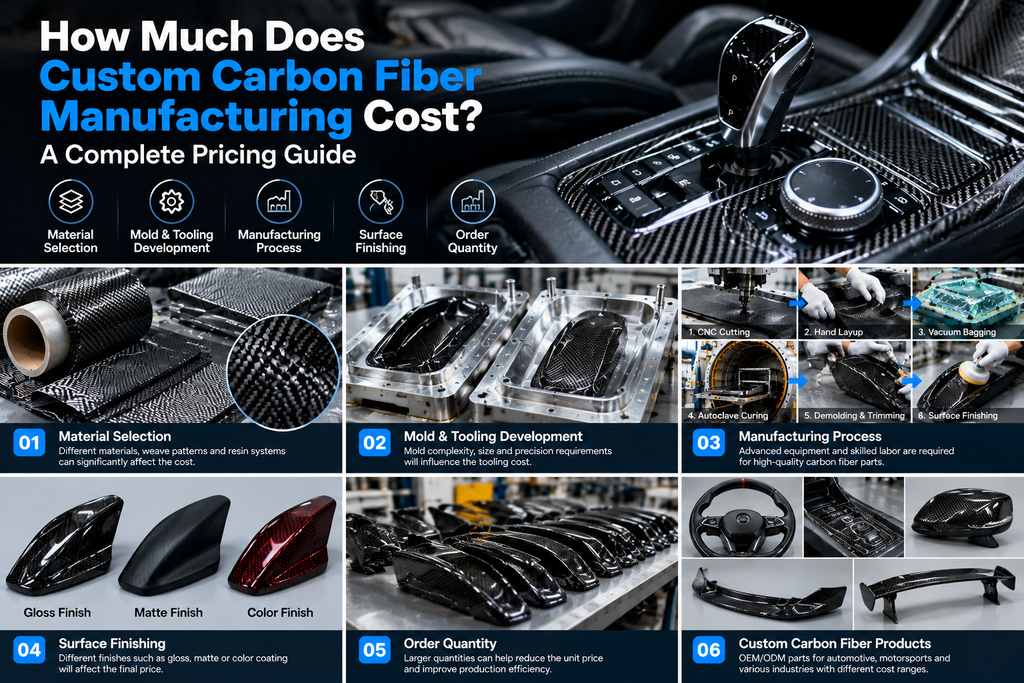
1. What Determines the Cost of Custom Carbon Fiber Parts?
There is no single price for all custom carbon fiber products.
A small decorative trim panel and a large molded carbon fiber housing may require completely different materials, estampación, labor, and production processes.
The following factors have the greatest influence on manufacturing costs.
1.1 Raw Material Selection
Carbon fiber materials represent an important part of the total manufacturing cost.
Common material options include:
- Carbon fiber prepreg.
- Dry carbon fiber fabric.
- Different fiber weave patterns.
- Different resin systems.
- Specialized composite materials for specific applications.
Prepreg materials are commonly used in controlled composite manufacturing processes because their resin content is established before layup.
Material selection should be based on the product’s intended application, requisitos de apariencia, mechanical properties, and manufacturing method.
Por ejemplo, visible automotive interior trim may prioritize weave consistency and surface appearance, while a structural component may require more detailed material and laminate engineering.
Higher material costs do not automatically guarantee a better finished product. The complete material system and manufacturing process must be evaluated together.
1.2 Mold and Tooling Development
Mold development is often one of the most important initial investments in a custom carbon fiber project.
If a customer wants to develop a completely new product, the manufacturer may need to create dedicated tooling based on a physical sample, 2dibujo, or 3D CAD model.
Tooling costs depend on:
- Product dimensions and geometry.
- Mold material and construction.
- Surface requirements.
- Dimensional tolerances.
- Production method.
- Expected production volume.
Products with complicated curves, deep shapes, or specialized mounting features may require more complex tooling.
Para compradores B2B, it is important to clarify whether the mold cost is a one-time development expense and who owns the tooling after payment.
1.3 Proceso de fabricación
Different manufacturing processes involve different equipment, labor, and production requirements.
Por ejemplo, a typical prepreg carbon fiber manufacturing process may include:
- CNC material cutting.
- Hand layup.
- Vacuum bagging.
- Curado en autoclave.
- Desmoldeo.
- Trimming and machining.
- Surface preparation.
- Painting and polishing.
Each stage requires appropriate equipment, skilled technicians, y control de procesos.
Complex components may require additional labor for precise material placement, acabado detallado, and dimensional inspection.
The selected process should match the product requirements rather than simply choosing the lowest-cost option.
1.4 Product Size and Design Complexity
The size and shape of a carbon fiber product directly influence material consumption and production difficulty.
Larger products generally require more material and may need larger molds and processing equipment.
Sin embargo, smaller components can also be expensive if they have complex geometry or tight dimensional requirements.
Por ejemplo:
- A simple flat carbon fiber panel may require relatively straightforward tooling.
- A curved automotive interior trim panel may require more detailed mold development.
- A complex exterior component may involve additional trimming, mounting features, and fitment verification.
Product geometry should therefore be evaluated before a final quotation is prepared.
1.5 Surface Finishing Requirements
Surface finishing is another important cost factor, especially for visible automotive components.
Common finishing options include:
Gloss Finish: Provides a reflective surface that highlights the carbon fiber weave.
Matte Finish: Creates a non-reflective appearance with a more understated style.
Color Coating: Adds a specified color or visual effect, depending on the coating system and product requirements.
Pulido: Helps improve surface smoothness and the overall appearance of the finished component.
The number of coating and finishing operations depends on the required appearance and quality standard.
Buyers should confirm their preferred finish before sampling to avoid unnecessary changes during development.
2. How Does Order Quantity Affect Custom Carbon Fiber Pricing?
Order quantity has a significant influence on unit pricing.
Custom manufacturing usually involves both initial development expenses and ongoing production expenses.
These costs should be considered separately.
Prototype and Sample Orders
The first sample may involve:
- Engineering evaluation.
- Mold development.
- Material preparation.
- Production setup.
- Manual processing.
- Sample inspection.
Como resultado, the unit cost of an initial sample is generally higher than the unit cost of a larger production order.
Sin embargo, sample development allows customers to verify product dimensions, apariencia, and assembly requirements before committing to mass production.
Small-Batch Production
Small-batch production is useful for businesses testing new products or introducing new SKUs.
It allows distributors and e-commerce sellers to evaluate market demand before investing in larger inventory quantities.
Although the unit cost may remain relatively high, a small pilot order can reduce inventory and product-development risks.
Producción en masa
Larger production orders may reduce the average unit cost through improved material planning, production scheduling, and more efficient use of tooling and labor.
Sin embargo, the actual savings depend on product design, manufacturing complexity, and production capacity.
Por esta razón, it is useful to request tiered pricing at different quantities when discussing a new project.
3. Tooling Cost vs. Unit Price: What Should Buyers Know?
When comparing custom carbon fiber quotations, buyers should distinguish between tooling costs and production costs.
These are two different parts of the project investment.
Tooling Cost
This is the initial expense associated with developing the mold or production tooling.
It is generally project-specific and may be incurred before the first production sample is completed.
Sample Development Cost
This covers the materials, labor, and manufacturing work required to produce evaluation samples.
Depending on the project agreement, sample costs may be quoted separately from tooling.
Unit Production Price
This is the manufacturing price for each finished product at a specified order quantity.
It can vary according to material consumption, processing time, finishing requirements, and production efficiency.
Additional Costs
Depending on the agreement, buyers may also need to consider packaging, etiquetado, testing, shipping, and applicable import charges.
A clear quotation should identify these cost items instead of combining everything into one unexplained price.
4. Why Are Two Similar Carbon Fiber Products Priced Differently?
Two carbon fiber products may look almost identical but have significantly different manufacturing costs.
There are several possible reasons.
Different Materials
Products may use different fiber specifications, fabric constructions, sistemas de resina, or laminate designs.
Different Manufacturing Methods
One component may be produced using prepreg and controlled curing, while another may use a different molding process.
These methods can involve different labor, equipo, and quality-control requirements.
Different Product Structures
A product’s external appearance does not reveal its internal laminate structure, espesor, or reinforcement design.
These factors can influence material consumption and manufacturing complexity.
Different Finishing Standards
Some products may receive additional coating, lijado, pulido, or cosmetic inspection.
Different Quality Requirements
A supplier producing according to defined dimensional tolerances and documented inspection standards may have different costs from a supplier offering only basic visual inspection.
Para compradores B2B, comparing products based on price alone can lead to misleading purchasing decisions.
It is important to compare equivalent specifications, materiales, processes, and quality requirements.
5. How to Reduce Custom Carbon Fiber Manufacturing Costs
A well-planned product development project can help control costs without compromising important quality requirements.
Here are five practical suggestions.
5.1 Provide Complete Product Information
Provide 2D drawings, 3Archivos CAD, muestras fisicas, dimensiones, and reference photographs whenever possible.
Complete information helps manufacturers evaluate the project more accurately and reduces unnecessary design revisions.
5.2 Confirm the Application Before Choosing Materials
Not every carbon fiber product requires the same material or manufacturing process.
Clearly explain whether the product is decorative, protective, estructural, or intended for another application.
This helps the manufacturer recommend an appropriate production approach.
5.3 Standardize Product Designs
If you plan to develop multiple similar products, consider whether some tooling or design features can be standardized.
This may simplify product development and production management.
5.4 Plan Order Quantities in Advance
Instead of requesting a quotation for only one quantity, ask for several production-volume options.
Comparing small-batch and larger-order pricing helps you understand the relationship between unit cost and order quantity.
5.5 Approve Samples Before Mass Production
Sample approval is essential for preventing costly production mistakes.
Confirm dimensions, mueble, apariencia superficial, and other important specifications before approving the production batch.
6. Which Carbon Fiber Products Can Be Custom Manufactured?
Custom carbon fiber manufacturing supports many different industries.
Componentes automotrices
Automotive applications include:
- Revestimiento de la consola central.
- Paneles decorativos para salpicadero.
- Adorno de puerta.
- Steering wheel trim.
- Gear shift panels.
- Cubiertas de espejo.
- Front lips and rear spoilers.
- Other interior and exterior components.
Vehicle compatibility, año modelo, installation points, and surface appearance should be confirmed during product development.
Drone and UAV Components
Carbon fiber can be used for selected drone frames, cubre, structural panels, and equipment housings.
The material and structure should be selected according to the intended operating conditions.
Artículos deportivos
Las aplicaciones potenciales incluyen componentes de bicicleta seleccionados., equipment shells, protective covers, and customized sporting equipment.
Industrial Products
Industrial applications may include lightweight covers, carcasas de equipos, composite panels, and specialized components.
Carcasas para productos de consumo
Custom carbon fiber shells can also be developed for selected premium consumer products and electronic equipment.
For shell-only projects, customers should clearly define which internal components will be supplied separately.
The manufacturer should confirm the scope of supply before quotation and production.
7. What Information Do You Need to Request a Carbon Fiber Quotation?
To receive a more accurate quotation, prepare the following information before contacting a manufacturer.InformationDetailsProduct NameWhat product do you want to manufacture?Reference MaterialPhysical sample, 2dibujo, or 3D CAD fileDimensionsOverall size and critical measurementsMaterialPreferred carbon fiber material or weave patternSurface FinishGloss, mate, or other specified finishInitial QuantityExpected sample or first production quantityFuture DemandEstimated monthly or annual purchasing volumeApplicationAutomotive, industrial, artículos deportivos, etc.Delivery ScheduleExpected sample and production deadlinesBrandingLogo, etiquetado, and packaging requirements
You do not necessarily need to have every technical detail finalized before contacting a supplier.
A physical sample or initial product drawing can be enough to start a preliminary feasibility discussion.
8. Custom Carbon Fiber Manufacturing at Shasha Carbon
Shasha Carbon focuses on carbon fiber product development and manufacturing for B2B customers.
With an established manufacturing operation and experience in carbon fiber processing, we support businesses looking for customized components and repeat production.
Our manufacturing capabilities include:
- Carbon fiber prepreg material preparation.
- Corte de CNC.
- Hand layup.
- Vacuum bagging.
- Curado en autoclave.
- Mold development.
- Trimming and polishing.
- Gloss and matte surface finishing.
- Product inspection.
We support OEM/ODM projects based on customer-provided samples, 2dibujos, and 3D CAD files, subject to technical feasibility.
Our product development experience includes automotive interior and exterior components, as well as selected customized carbon fiber products for other industries.
Our B2B Cooperation Process
1. Project Evaluation
Customers provide product information, muestras de referencia, or technical drawings.
2. Technical Review and Quotation
We evaluate the manufacturing requirements, necesidades de herramientas, materiales, and estimated production costs.
3. Mold Development and Sampling
After project confirmation, tooling and sample development can begin.
4. Aprobación de muestra
Customers review the sample and confirm the agreed specifications.
5. Batch Production
Mass production proceeds according to the approved sample and project requirements.
We focus on business customers, including automotive parts distributors, vendedores de comercio electrónico, marcas, y fabricantes.
Our services are designed for OEM/ODM development and batch manufacturing rather than individual one-piece customization.
9. Frequently Asked Questions About Custom Carbon Fiber Costs
How much does it cost to make a custom carbon fiber part?
The cost depends on product dimensions, selección de materiales, mold complexity, manufacturing method, acabado superficial, and order quantity. A quotation requires sufficient product information to evaluate these factors.
Is mold development included in the unit price?
No necesariamente. Tooling is often quoted separately as an initial development expense. Buyers should confirm this with the manufacturer before placing an order.
Is custom carbon fiber manufacturing expensive?
Custom carbon fiber production can involve significant initial investment, particularly when new tooling is required. Sin embargo, costs can be managed through suitable material selection, efficient product design, and planned production quantities.
Can I start with a small production order?
Many manufacturers can discuss small-batch pilot production, depending on product complexity and tooling requirements. This can help businesses test market demand before increasing order quantities.
Can I get a quotation without a 3D drawing?
Sí. A physical sample, 2dibujo, or clear reference information may be sufficient for an initial assessment. More detailed technical information may be required before final tooling and production.
¿Cuánto tiempo lleva el desarrollo de fibra de carbono personalizada??
Development time depends on product complexity, requisitos de herramientas, disponibilidad de materiales, revisiones de muestra, y programación de la producción. Ask the manufacturer to provide separate estimates for tooling, muestreo, y producción en masa.
Conclusión
The cost of custom carbon fiber manufacturing depends on much more than the raw material price.
Tooling development, product geometry, manufacturing methods, acabado superficial, requisitos de calidad, and order quantity all influence the final quotation.
Para compradores B2B, the best way to control costs is to prepare clear product specifications, select an appropriate manufacturing process, approve samples, and plan production quantities carefully.
Whether you are developing a new automotive accessory, launching a private-label product, or expanding your existing product range, choosing an experienced manufacturing partner is an important part of building a reliable supply chain.
Looking for a custom carbon fiber manufacturing quotation?
Contact Shasha Carbon and send us your product drawings, 3archivos D, o información de muestra física.
Tell us your estimated order quantity, preferred finish, and application requirements. Our team can evaluate your project and discuss a suitable OEM/ODM manufacturing solution.
Shasha Carbon – Your B2B Partner for Custom Carbon Fiber Manufacturing.


